The following blog was written by Courtney Kemnitz a digitiser in the Herbarium.
Since 2021 we have increased our digitisation capacity reaching 1 million specimens imaged in August 2024. Each digitiser is assigned a family of plants to work through. This series of blogs will spotlight the families that have been completed by a member of the team.
It’s been known by many names over the years such as the “Telle du Conquest”, “William’s Little Cloth”, and “Queen Matilda’s Tapestry,” but it is best known as the Bayeux Tapestry.
Though technically an embroidery, the Bayeux Tapestry tells the story of the Norman conquest of England in 1066, when the Battle of Hastings resulted in Willliam of Normandy’s victory over King Harold II. The work depicts events over a 2-year period (1064-1066) and shows not only the events of the battle, but also many aspects of Anglo-Norman & Anglo-Saxon life, such as medieval ship building, fashion, weapons, and armour. The tapestry provides a fascinating historical record of a momentous political event, its players, their dress, hair styles, implements and so much more. It is, therefore, an artefact of great importance for the study of the entire middle ages, not just warfare, and a large artefact at that! The Bayeux Tapestry is approximately 68.8 meters (225.7 feet) long and 50 centimetres (19.6 inches) high and weighs 350 kilograms!
It is believed to have been made sometime in the 1070s, most likely in the south of England, likely either in Canterbury (an important cultural centre at the time) or Winchester (known for its embroidery at the time). Many scholars believe it was commissioned by Odo the Bishop of Bayeaux, William the Conqueror’s half brother, who would later become the Earl of Kent.
In 2007 the Bayeaux Tapestry was registered as a part of UNESCO’s Memory of the World (MoW) Programme. MoW’s primary aim is to promote the preservation and accessibility of documentary heritage (i.e. movable items that can be reproduced, and shared) of universal value.
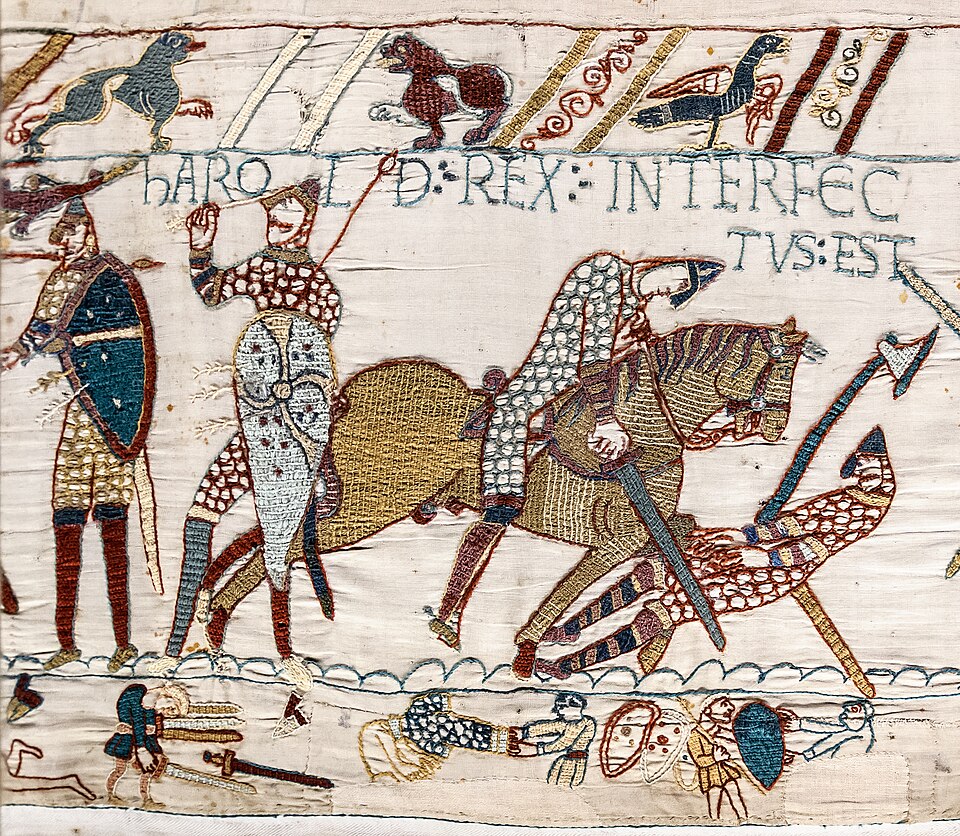
Titulus: HIC HAROLD REX INTERFECTUS EST (Here King Harold is slain)
https://commons.wikimedia.org/wiki/File:Bayeux_Tapestry_scene57_Harold_death.jpg

How it was Made
There is no contemporary account of how the Tapestry was made, but extensive scientific analysis carried out over the years has yielded much information.
The Bayeux Tapestry was constructed using primarily linen and wool. Including the material used to dye the wool, there were 4 primary plants1 that were used to create the Tapestry:
- Linum usitatissimum (linen): the primary canvas material, mixed with some hemp fibres
- Isatis tinctoria (woad): used for the varying shades of blue (and mixed with weld for the greens)
- Rubia tinctorum (madder): used for the terracotta reds and oranges.
- Reseda luteola (weld): Used for the yellows (and mixed with woad for the greens).
The Canvas: Linum usitatissimum
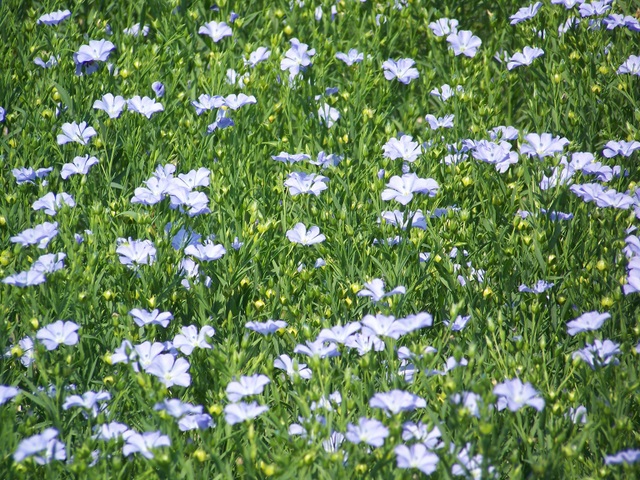
By Trish Steel, CC BY-SA 2.0
,_near_Whitsbury_-_geograph.org.uk_-_1377610.jpg)
The base of the whole tapestry is primarily made out of Linum usitatissimum, better known as linen or common flax with some hemp fibres mixed in. It was common in the Medieval period for mixed fibres like linen and hemp to be for textiles and fabric.
The Tapestry is made up of nine sections of linen, the first 7 of which are between 6-8 meters long each, and the last two are just under 3 meters each. It has undergone many repairs in its lifetime and was lined with a second linen cloth between 15th & 17th century and a number of linen patches have been added over the years to cover tears and holes.
The origin of the linen remains a mystery. While it is assumed that the linen was manufactured in England, it is entirely possible it was imported. Further study of linen manufacturing in not only England but the whole of Europe during the 11th century, would provide much needed insight into this question.
A Closer Look
Name: Linum usitatissimum L.
Family: Linaceae
It was first described scientifically in 1753 by Swedish botanist Carl Linnaeus in Species Plantarum
Believed to be a domesticated form of the wild plant flax, Linum bienne.
Common Names in the British Isles and the Isle of Ireland*
| Language | Name |
| English | Linen, common flax, linseed |
| Scots | lin, blae, lint |
| Scottish Gaelic | lìon, lìon-coitcheann, lìonan |
| Irish/ Gaeilge | lìon, línéadach |
| Welsh | llin, ffibr llin |
| Manx | Aanrit, eaddagb-liecn, lieen |
| Cornish | Linen, linennow, linednow |
| Anglo-Saxon | Línen, fleax |
| Anglo-Norman | linen teile |
*List is not exhaustive
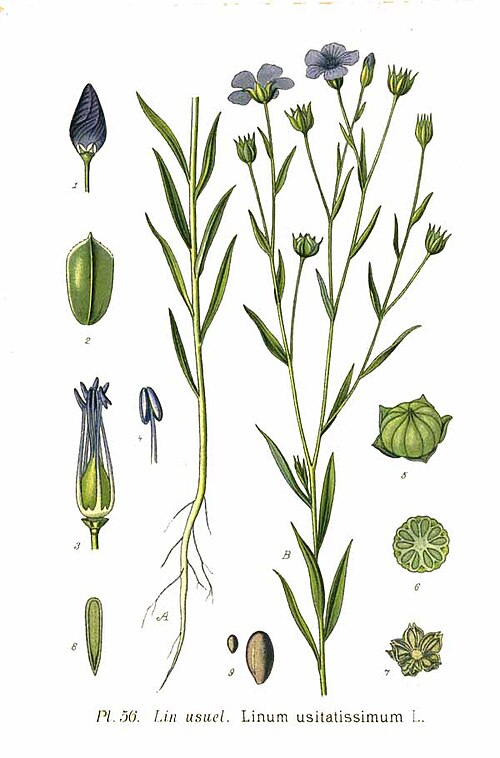

Linum usitatissimum, or flax, is an annual flowering plant and one of the oldest continuously cultivated plants in the world. It typically grows in sunny environments; this plant can grow up 30-120cm tall with a slender stalk and branches at the top.
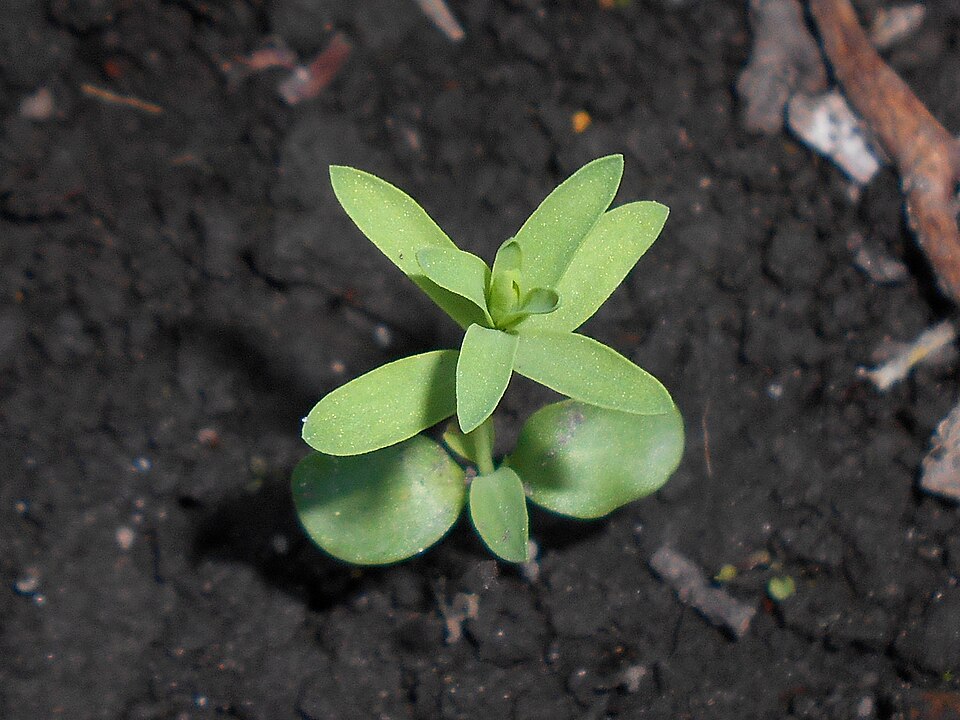
By Salicyna – Own work, CC BY-SA 4.0

The leaves are small, lance-shaped (i.e. long and narrow), and arranged in alternating positions up the stalk. They measure 20-40mm in length and 1-5mm wide.
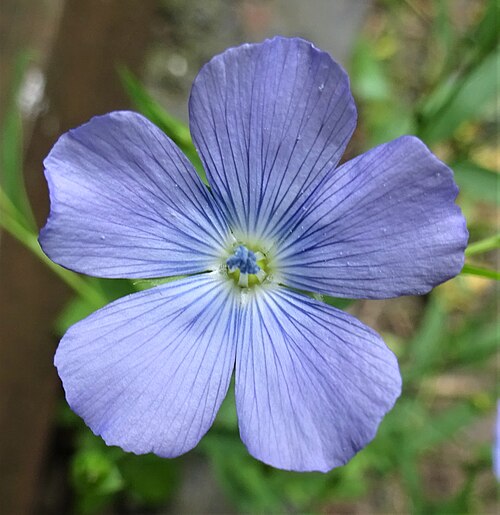
By Rosser1954 – Own work, CC BY-SA 4.0
_flower._Chapeltoun_North_Ayrshire.jpg)
This plant blooms in the summer, producing blue flowers with five petals, but these can sometime be white or pink. The fruits are small dry capsules with five lobes.
Royal Botanic Garden Edinburgh (RBGE) Herbarium Specimens
The digitisation of this species within our British Isle collections is now complete which allows us to see how our collections are distributed and compare this to the species range data recorded by the Botanical Society of the British Isles (BSBI).
Total number of Specimens held in the British and Irish Collection within the Herbarium*: 65 Specimens
*Please note, that the Herbarium contains more specimens of Linum usitatissimum from other parts of the world. These figures are not included.
Breakdown by Region
| Country | Specimen Count |
| Scotland | 51 |
| England | 14 |
| Wales | 0 |
| Channel Islands | 1 |
| Ireland (Republic of Ireland & Northern Ireland) | 0 |
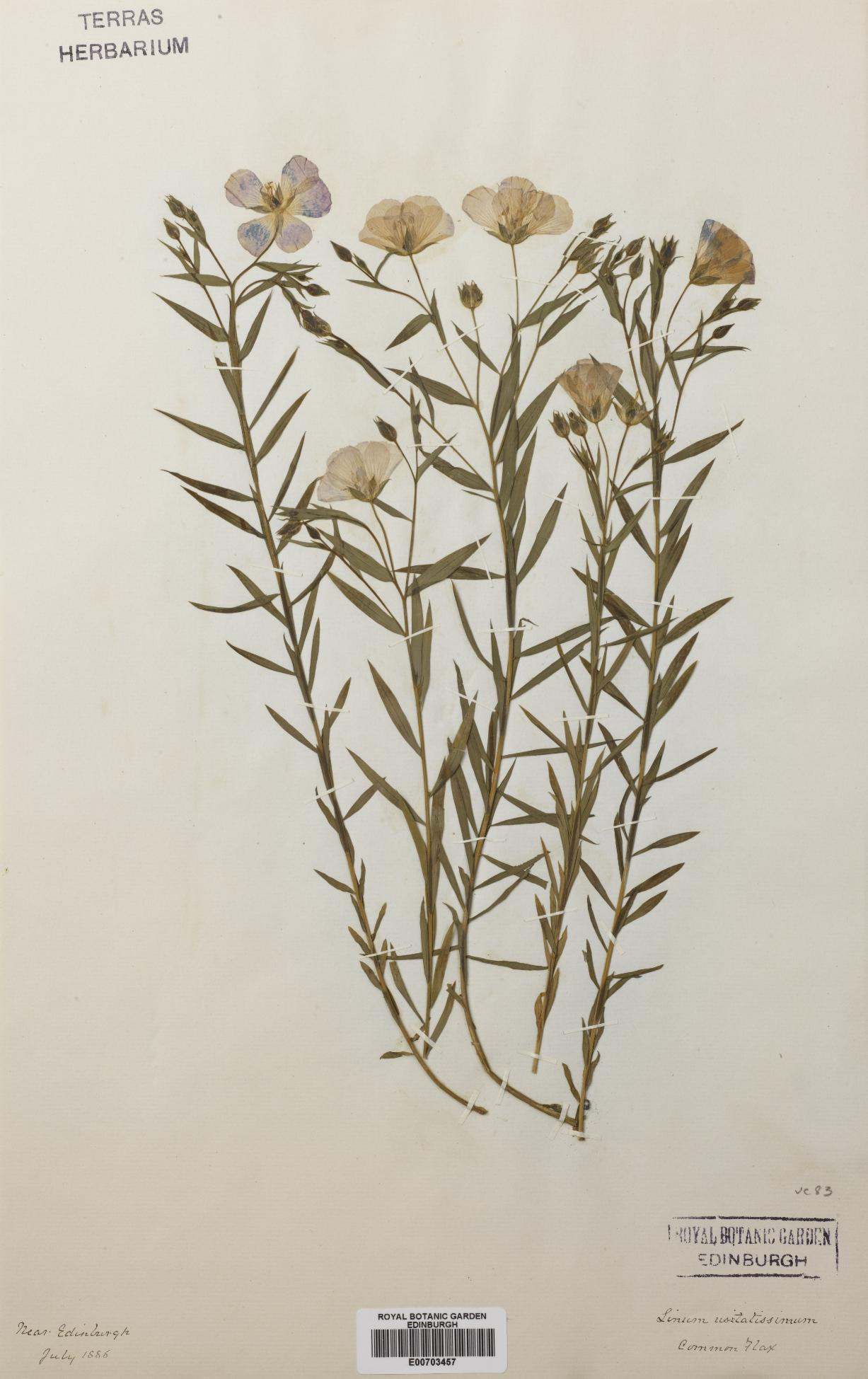
Distribution
Its native range is from Türkiye to Iran but has spread across the world and now grows in areas with temperate regions across northern Africa, Asia, North America, and Southern South America.
In the United Kingdom and Ireland, it primarily is found in from the Midlands to southern and southeast England. Linum usitatissimum is known as a cultivated archaeophyte. Meaning it is a non-native (alien) plant that was introduced and became established between Neolithic period and AD1500. It is believed to have been cultivated in the United Kingdom and Ireland since at least 1240 and was spreading naturally by the 1630s.
Although it was initially grown for making textiles, it has increasingly shifted towards the production of linseed oil since the 1990s.
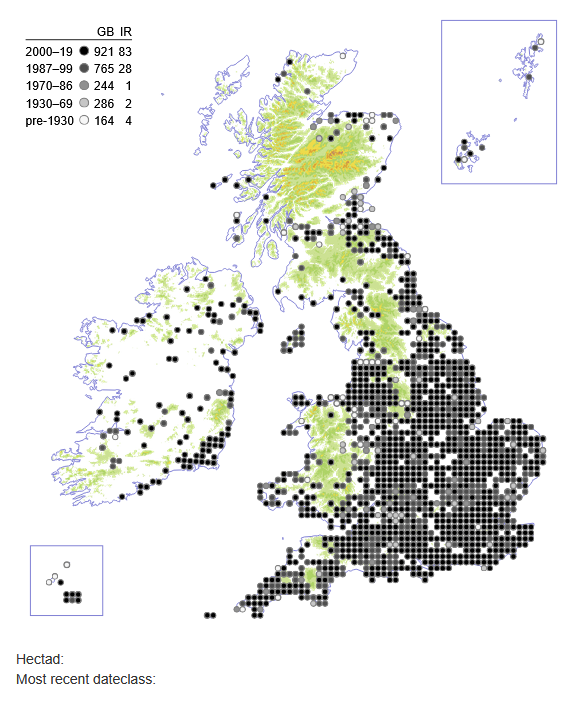
For a map of the worldwide distribution of Linum usitatissimum L. please visit the website: Plants of the World Online.
Turning Linum usitatissimum (flax) into Linen
Linen is one of the oldest textile fibres in the world, with documented evidence of its use since prehistoric times. Linen is known for its many qualities including: strength, durability, heat conductivity, moisture absorbency, resistance to microorganisms and its smooth surface that repels dirt. This makes it ideal for hot climates and undergarments. Today, linen continues to be a popular fabric for summer wear.
Linen is also a very sustainable fabric. The cultivation of flax, when grown in its idea geographical zone it is quite easy to grow and requires little intervention. In addition to making linen, other parts of the plant can be used to make paper, varnish, oil, animal fodder and biomaterials.
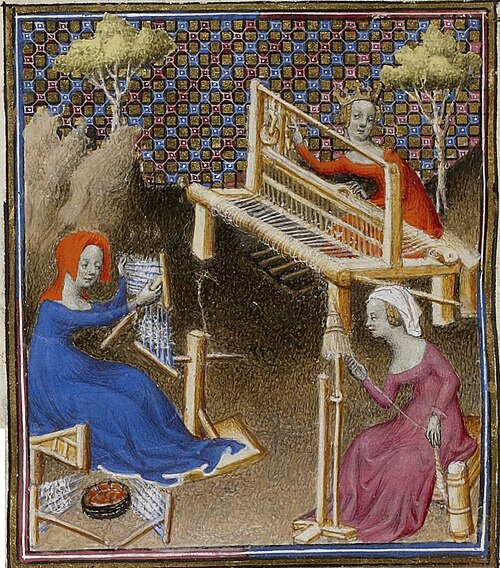
https://commons.wikimedia.org/wiki/File:Weaving,_spinning,_and_combing_flax.jpg

The making of linen is labour intensive. In order to make flax (L. usitatissmum) into a fibre, it is typically harvested just after the stalk has yellowed but before the fruit is fully matured. To extract the fibre, the plant is first then dried out, then goes through a process called retting, which separates the fibres from the stalk. Retting is where the dried plants are exposed to moisture and left to rot, allowing microorganisms to breakdown the surrounding tissues. When grown in its ideal climate, this can be done via dew retting, where dried bundles are spread across a field and left to decompose.
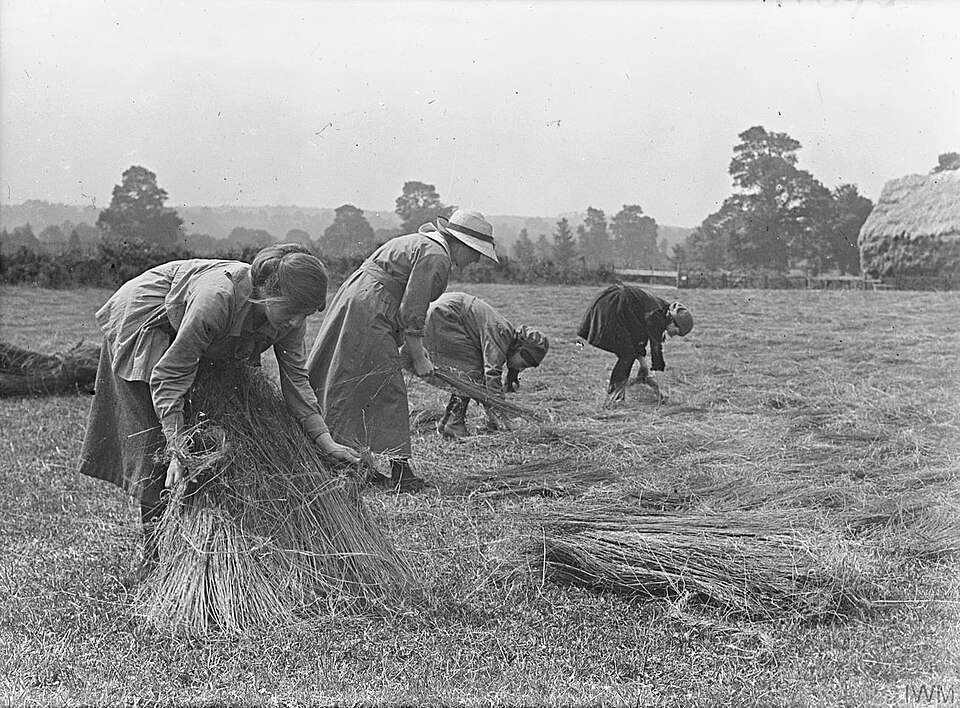
Photographer: Horace Nicholls. © Imperial War Museums (Q 30902)
Once the fibre has been separated, the straw around it is removed in a process called scutching. The last step before being turned into a fabric is to comb the fibres to remove any bits of straw and to align the fibres. This results in smooth fibres strands that measure about 30-75cm long ,ranging in colours from buff to grey, with the best quality strands being a creamy white. These fibres are then taken to be spun into yarn and woven into linen cloth.
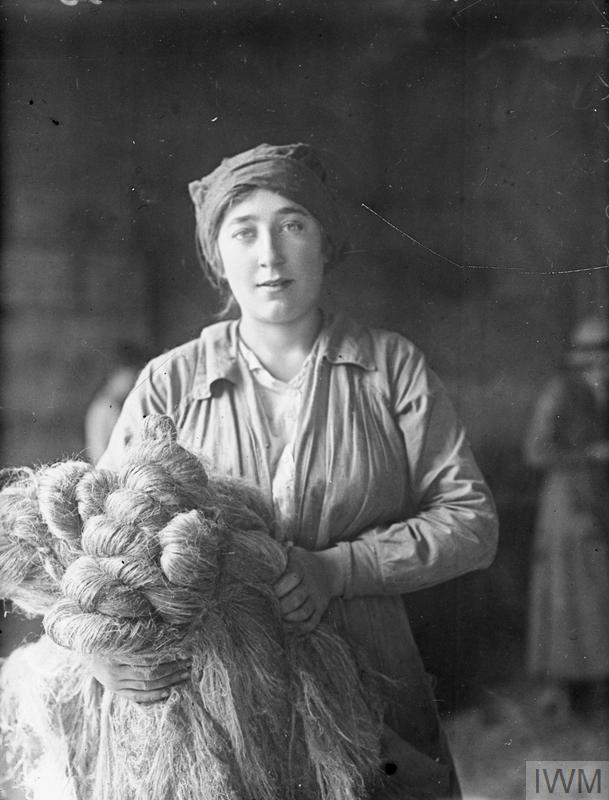
Photographer: Horace Nicholls. © Imperial War Museums (Q 30907)
By the 11the century, Linum usitatissimum had become a staple crop in southern England and cultivated widely for the making of linen. Up until the 1800s, the cultivation of flax and the manufacturing of linen was scattered across rural areas of the UK and Ireland. With the rise of the industrialisation, the production of linen expanded across the UK and Ireland as it transitioned from local rural industry to large-scale manufacturing.
The industry declined in the early 20th century in the UK and Ireland primarily due to the mass production of cotton, the introduction of synthetic fibres and the outsourcing of labour to other nations with lower labour costs. Today, however, approximately 70% of the world’s flax is grown in Europe.
Part I was about the canvas, the linen: Linum usitatissimum, part II will focus on the plants used to dye the wool: Rubia tinctorum, Reseda luteola, and Isatis tinctoria. More commonly known as madder, weld, and woad.
Part I Sources:
Bayeux Museum (2019). Tapisserie de Bayeux – The Bayeux Tapestry. [online] Bayeux Museum. Available at: https://www.bayeuxmuseum.com/en/the-bayeux-tapestry/
Britannica (2019). flax | Description, Fiber, Flaxseed, Uses, & Facts | Britannica. In: Encyclopædia Britannica. [online] Available at: https://www.britannica.com/plant/flax.
The Botanical Society of Britain & Ireland (BSBI) (2015). Archaeophytes. [online] Bsbi.org. Available at: https://bsbi.org/learn/getting-started/terms/general-terms/archaeophytes.
The Botanical Society of Britain & Ireland (BSBI), Wilmore, G.T.D. and Stroh, P.A.S. (2020). Linum usitatissimum. [online] bsbi.org. Available at: https://bsbi.org/taxa/2cd4p9h.8sy/linum-usitatissimum
Bulger, Sarah (2019) “It’s Elementary: The Bayeux Tapestry as a Medieval Educational Tool,” OUR Journal: ODU Undergraduate Research Journal: Vol. 6 , Article 1. Available at: https://digitalcommons.odu.edu/ourj/vol6/iss1/1
The Global Biodiversity Information Facility (2022). Linum usitatissimum L. [online] gbif.org. Available at: https://www.gbif.org/species/113628059. GBIF species pages extracted from English Wikipedia.
Hagger, M. (2024). The Making and Meaning of the Bayeux Tapestry Revisited. Journal of Medieval History, 50(2), 214–235. https://doi.org/10.1080/03044181.2024.2324055
Karg, S. New research on the cultural history of the useful plant Linum usitatissimum L. (flax), a resource for food and textiles for 8,000 years. Veget Hist Archaeobot 20, 507–508 (2011). https://doi.org/10.1007/s00334-011-0326-y
Lester-Makin, A. (2016), ‘The Front tells the Story; the Back tells the History: a technical discussion of the embroidering of the Bayeux Tapestry’ in Making Sense of the Bayeux Tapestry: Readings and Reworkings, Making Sense of the Bayeux Tapestry: readings and reworkings, Manchester: Manchester University Press, pp. 23-40.
Lewis, M., & Gameson, R. (2024). Palette, Pigments and Pictorial Narrative in 11th-Century England: The Use of Colour in the Bayeux Tapestry and the Old English Hexateuch. Journal of the British Archaeological Association, 177(1), 22–48. https://doi.org/10.1080/00681288.2024.2328966
Norton, Christopher (2019) Viewing the Bayeux Tapestry, Now and Then, Journal of the British Archaeological Association, 172:1, 52-89, DOI: 10.1080/00681288.2019.1642012
Searle, G. O. (1936). THE PAST AND FUTURE OF FLAX PRODUCTION IN GREAT BRITAIN. Journal of the Textile Institute Proceedings, 27(7), P197–P207. https://doi.org/10.1080/19447013608662897
UNESCO (2024). Bayeux Tapestry. [online] Unesco.org. Available at: https://www.unesco.org/en/memory-world/bayeux-tapestry. Added to the register in 2007.
Victoria and Albert Museum. “Linen – the Original Sustainable Material.” Victoria and Albert Museum, 17 Apr. 2024, www.vam.ac.uk/articles/linen-the-original-sustainable-material.
Dictionaries
- Anglo-Saxon: Bosworth-Toller Anglo-Saxon Dictionary online
- Anglo-Norman: Anglo-Norman Dictionary (https://www.aber.ac.uk/en/modernlangs/research/current-research/anglo-norman-dictionary/)
- Irish Gaelige: téarma.ie | An Bunachar Náisiúnta Téarmaíochta don Ghaeilge · The National Terminology Database for Irish & New English-Irish Dictionary from Foras na Gaeilge
- Cornish: Gerlyver Kernewek