By John Wilkins
Professor Emeritus of Greek Culture, University of Exeter
Botanists will be familiar with the names of Theophrastus and Dioscorides who organised the description of plants systematically before Linnaeus. Theophrastus (4th century BC) in the History of Plants and Causes of Plants extended Aristotle’s History of Animals to the plant world in the wake of Alexander the Great’s expedition to the Indus and discovery of many Asian plants. Dioscorides organised medical plants in the first century AD.
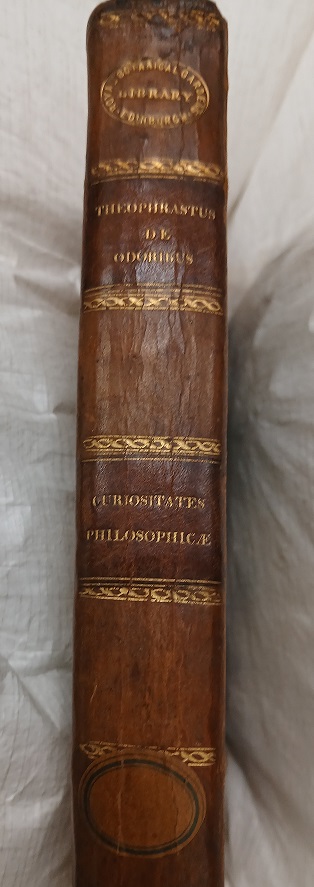
The RBGE Library has a copy of Theophrasti libellus de odoribus (Theophrastus On Odours) by Adrianus Turnebus (view the Library Catalogue record). The French humanist brought out the volume in Rue Jacob, Paris, in 1556 and dedicated it to Margaret, sister of Henri II.
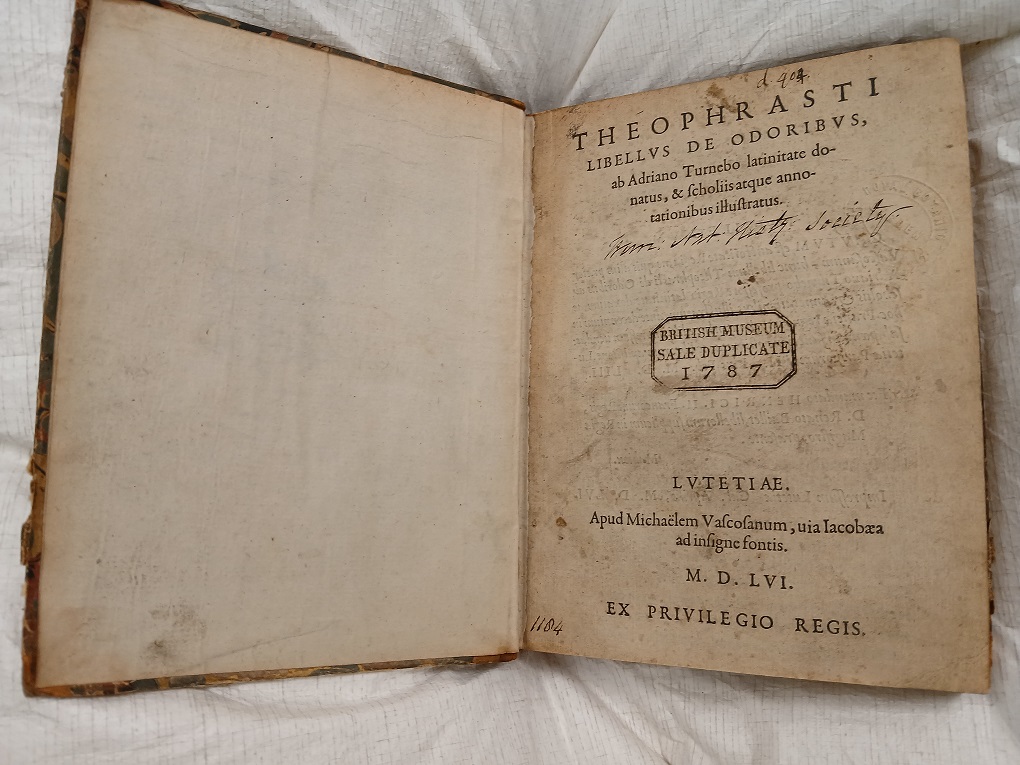
It consists of three parts, his Latin translation of the Greek text (4-15); notes on the Greek text in support of his translation (16-32); the Greek text (new numeration 1-11). He makes clear the poor state of the text transmitted by the manuscripts and introduces many corrections, supplements and emendations. A large number are still incorporated in the standard modern text, as seen in the Teubner edition by Georg Wöhrle (1991). Turnebus is a valuable witness to the text at the time that numerous manuscripts had been written only a little before (the majority are fifteenth century) and the printed editions of Humanists had important corrections to make.
The volume of Turnebus is bound with another volume written 150 years later (view the Library Catalogue record).
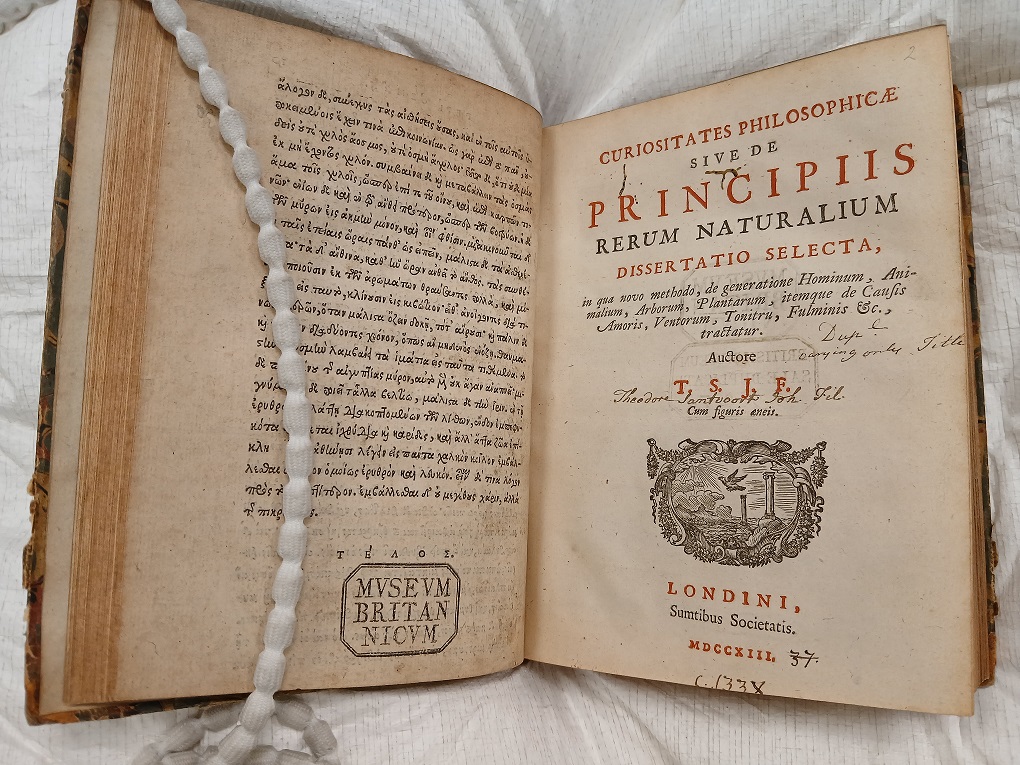
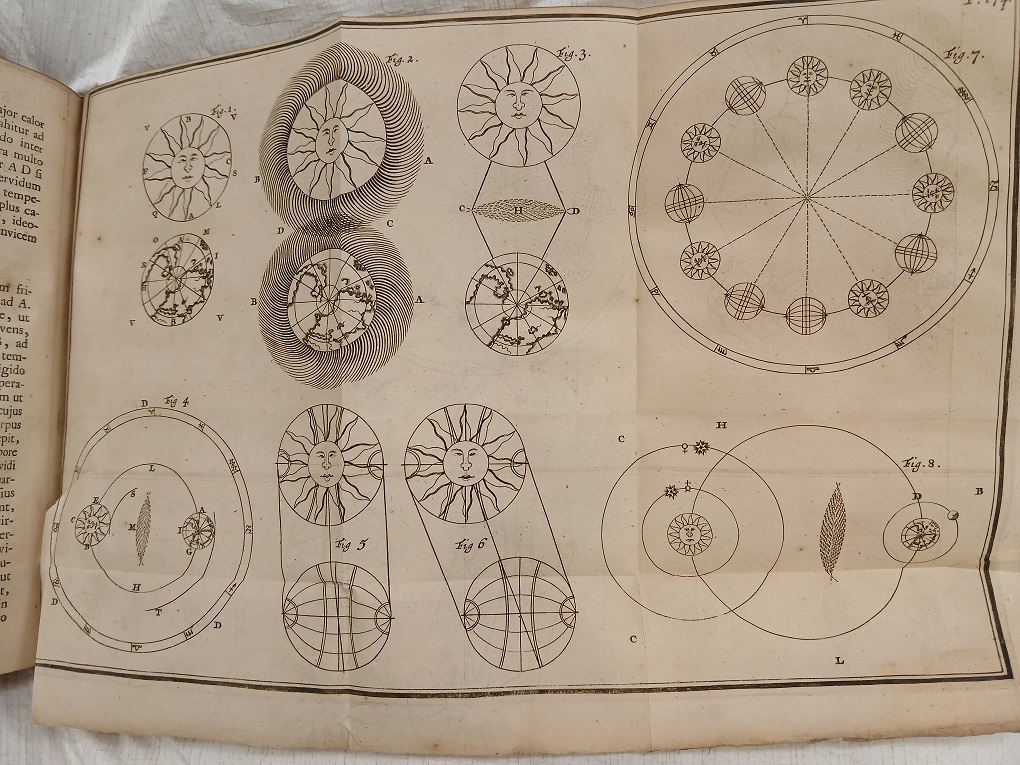
Curiositates philosophicae sive de principiis rerum naturalium. Dissertatio selecta by T.S.J.F. (London, sumptis societatis, 1713) presented numerous topics, among them a ‘new method’, the generation of people, animals, trees and plants, the causes of love, of winds, of thunder and lightning, magnets, burning mountains and the principles of solid bodies. 339 pages in all. The chapter on winds includes maps of the eastern Indian Ocean and of the South Atlantic, while there are diagrams of the sun and heavenly bodies in the discussion of solid bodies.
Why were the Curiositates bound with Turnebus? Diogenes Laertius Lives of Eminent Philosophers book 5 provides the answer (3rd century AD?). Theophrastus wrote a vast number of treatises, listed by Diogenes but mostly now lost or surviving in fragments, except for such valuable works as History of Plants, Causes of Plants and On Odours. He wrote on stones, on animals, plants and trees; on the winds, on astronomy, and even on the causes of love, among many other topics. The author of Curiositates, then, has summarised some of the topics of Theophrastus, rather in the style of the Natural History of Pliny the Elder (before 79 AD).
The Library’s volume offers a valuable sixteenth-century edition of Theophrastus, On Odours, bound with an eighteenth century version of some of the lost works of Theophrastus on Natural Philosophy.