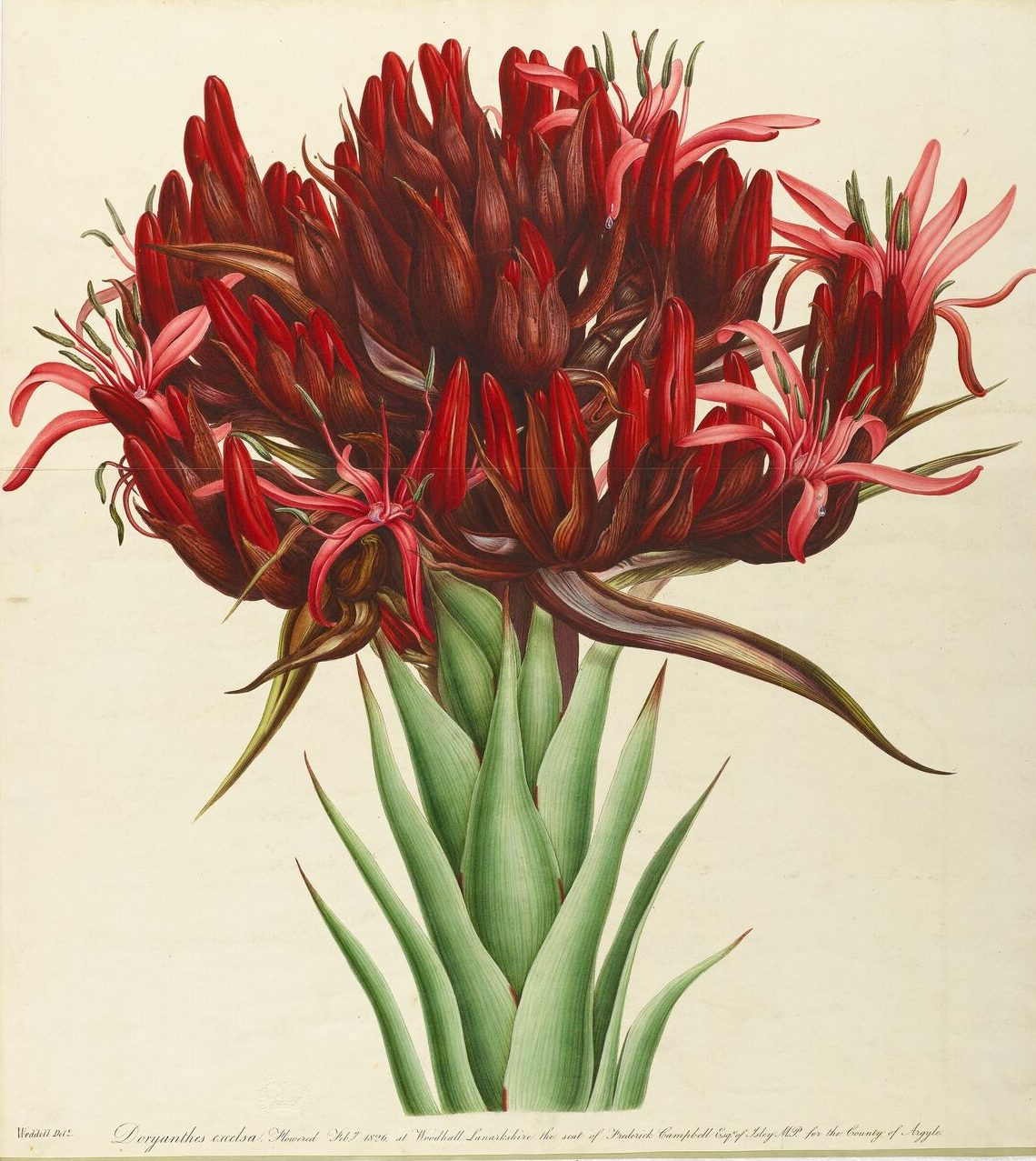
In a paper published in 2014 (see extract below) I discussed an illustration of the spectacular carmine inflorescence of the gymea lily (Doryanthes excelsa Corrêa, Doryanthaceae) in a category that I denoted a ‘swagger print’. Issued in a tiny edition it is inscribed ‘Weddell delt.’ and almost certainly the work of Edward Smith Weddell, rather than his brother Henry Hopkins Weddell. The specimen of the Australian giant herb depicted flowered in February 1826 in the garden of Woodhall, near Airdrie, Lanarkshire, one of the seats of Walter Frederick Campbell of Islay and Woodhall (1798–1855). That the inscription makes no mention of the engraver, merely the delineator, would suggest that the print was based on a drawing by Weddell himself. However, while unquestionably the engraver, his role as draughtsman is more doubtful and in the paper I raised the question of where the original drawing was made. Was the inflorescence chopped and sent to London; or might Weddell have travelled to Scotland to make the drawing? Both seemed unlikely – a prolific, London-based artisan is hardly likely to have been prepared to take a time-consuming and onerous journey as far as Lanarkshire to make a single drawing, even if well-paid for his efforts; the likelihood that a cut inflorescence would have remained in a drawable state after such a journey, whether by stagecoach or ship, seems even less likely.
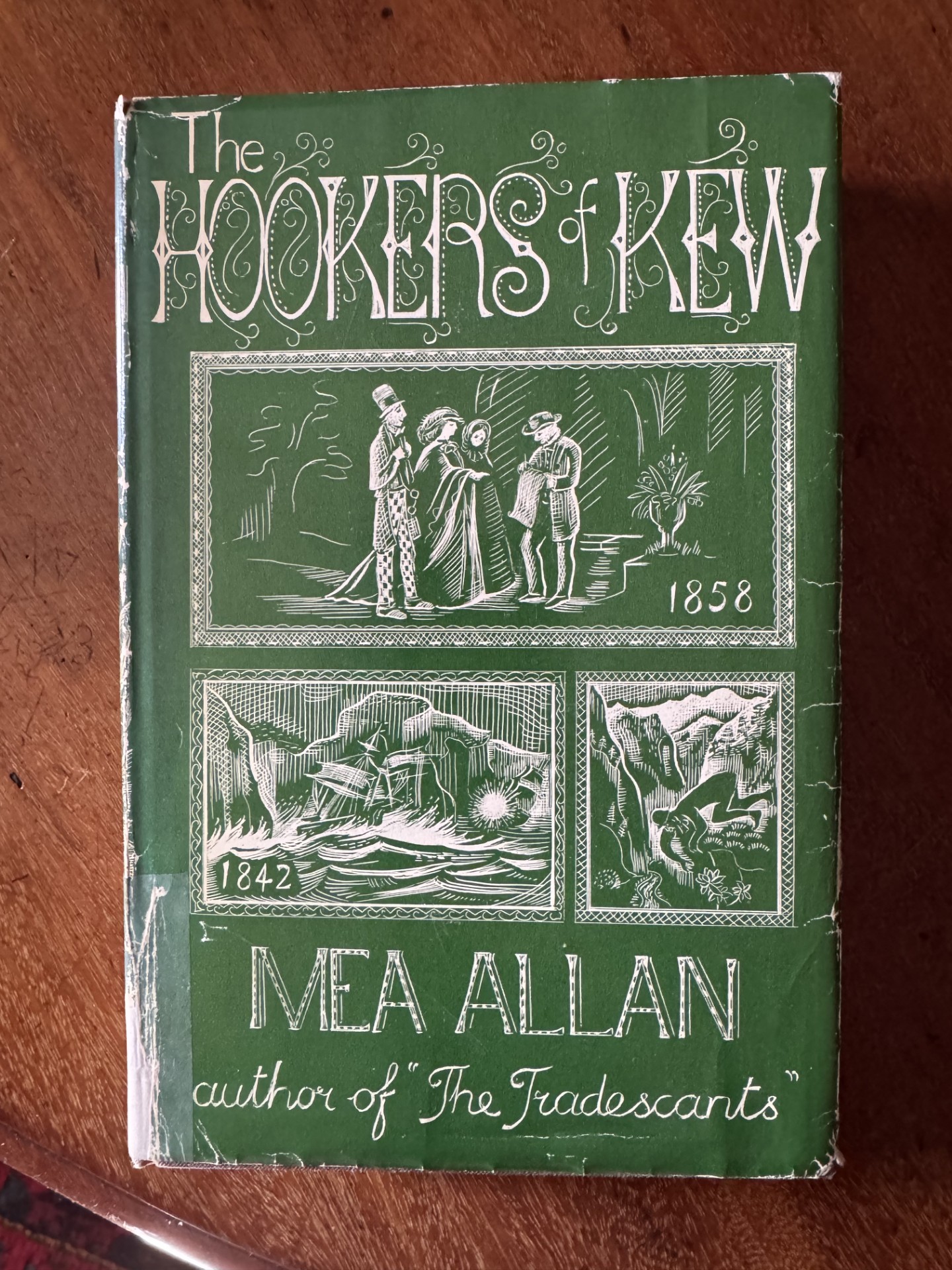
On rereading Mea Allan’s The Hookers of Kew, a joint biography of William and Joseph Hooker (if ambiguously titled), I was intrigued to find a possible answer. It turns out that the elder Hooker made a visit to view the flowering Doryanthes at Woodhall, a carriage ride from Glasgow, where he had by then been Professor of Botany for five years. The invitation came not from the garden owner, but from his uncle, Lord John Campbell (later 7th Duke of Argyll). Allan’s biography is a period piece and, while thoroughly researched and eminently readable, is poorly referenced, with no source given for the information relating to the visit. Nothing relevant appears to be in the Hooker correspondence at Kew, but in 1967 Allan had access to papers then in the possession of the Hooker family, which may have been the source. The visit clearly left a deep impression on Hooker, who recalled it 30 years later when a specimen of the plant flowered at Kew, if in a less spectacular fashion.
But why Lord John, rather than his nephew Walter Campbell, who extended the invitation? In a biography of his father Joseph Hooker recalled that Lord John, well-known for his scientific interests, was a friend of William Hooker. Before his purchase of a cottage at Invereck (close to Benmore) the elder Hooker had taken holidays ‘Doon the Watter’ at Helensburgh, the location of Lord John’s seat of Ardencaple. The peer had been Whig MP for Argyllshire from 1799 to 1822 when his seat was taken by his nephew. In 1826 Walter Frederick was taking his public duties seriously and as the House of Commons (under the premiership of the Tory Lord Liverpool) was sitting from 2 February, he was far from Woodhall, and doubtless attending parliament in London. Perhaps he had asked his uncle to keep an eye as the giant spear of the Doryanthes inflorescence thrust ever upwards. The intriguing possibility therefore arises that it was Hooker, a skilled botanical artist, who made a sketch of the living plant on which Weddell based his print after some reworking that would avoid the need to acknowledge the original artist, and justify signing the print in his own name.
Acknowledgement
I am grateful to Kiri Ross-Jones for seeking any letters from 1826 from Lord John or Walter Frederick Campbell in the Hooker correspondence at Kew.
References
Allen, Mea (1967). The Hookers of Kew. London: Michael Joseph.
Hansard. https://api.parliament.uk/historic-hansard/sittings/1826/index.html
Hooker, J.D. (1903). A Sketch of the Life and Labours of Sir William Jackson Hooker Late Director of the Royal Gardens of Kew. Oxford: Clarendon Press.
Noltie, H.J. (2014). Doryanthes excelsa and Rafflesia arnoldii: two “swagger prints” by Edward Smith Weddell (1796–1858). Archives of Natural History. 41: 189–208.
The Weddell drawing and print (edited extract from Noltie, 2014)
It should be noted that the Doryanthes print is signed only “Weddell”, fairly certainly the work of Edward Smith Weddell. But where was the original drawing made? The living plant is extremely large – 23½ feet on its second Woodhall appearance – and even if it were grown in a tub it is hardly likely that this would have been sent to London by road or sea for Weddell to draw. It is conceivable that Weddell travelled to Lanarkshire to draw it in situ – given the long lead-up to flowering, there would have been plenty of time to arrange this – but this seems unlikely. More probably the top of the inflorescence was lopped and sent to London, which would explain why there is no representation of the habit of the plant on the plate.