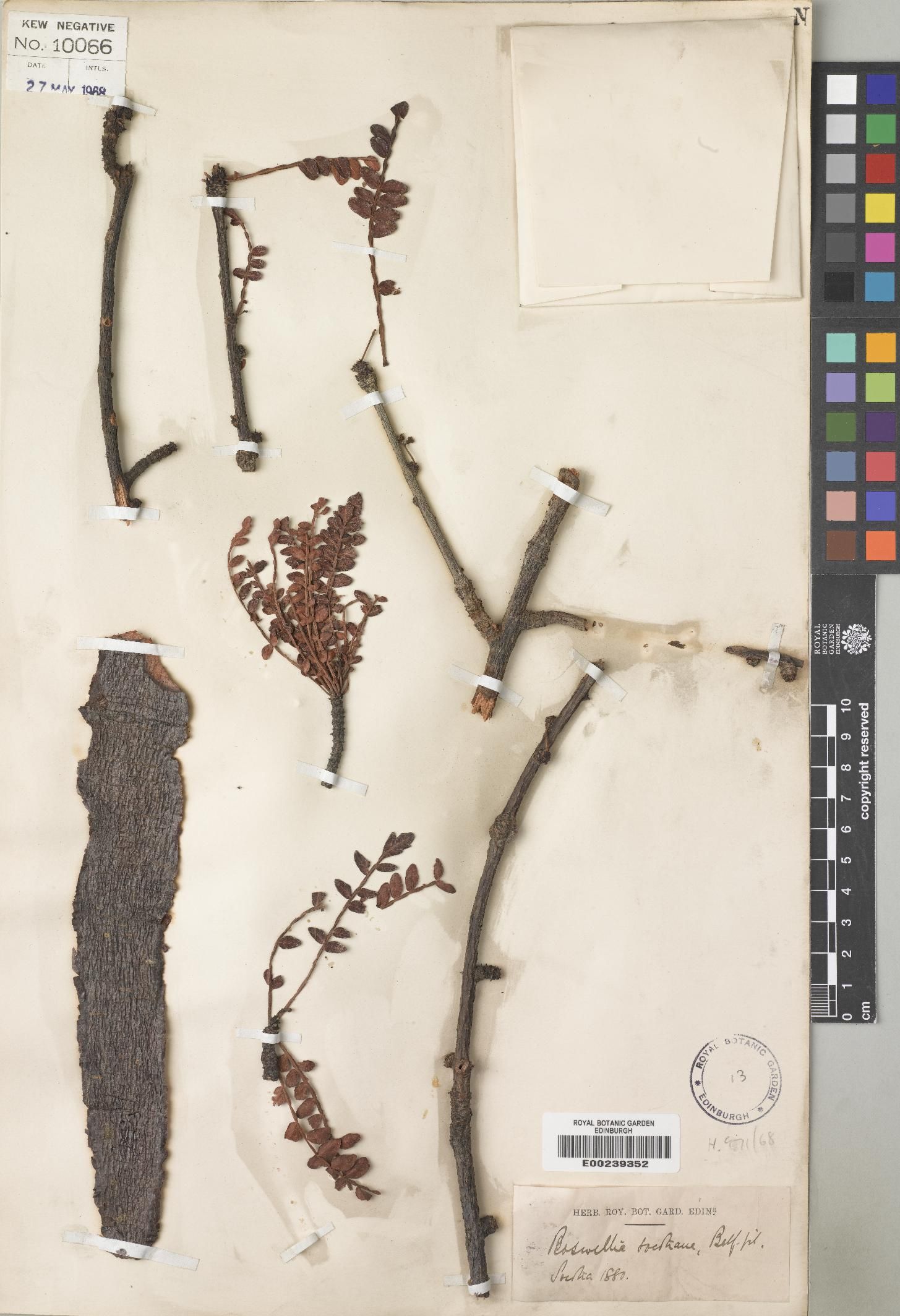
The following blog was written by Linde Hess a digitiser in the Herbarium.
Since 2021 we have increased our digitisation capacity reaching 1 million specimens imaged in August 2024. Each digitiser is assigned a family of plants to work through. This series of blogs will spotlight the families that have been completed by a member of the team.
The Burseraceae family (at the time of typing this piece) consists of 18 genera and 771 accepted species. Species of this family can mostly be found near the equator, from North Brazil up to Northern Mexico, Tropical and Northern Africa, Southern Asia and from the Philippines down to Northern Australia.
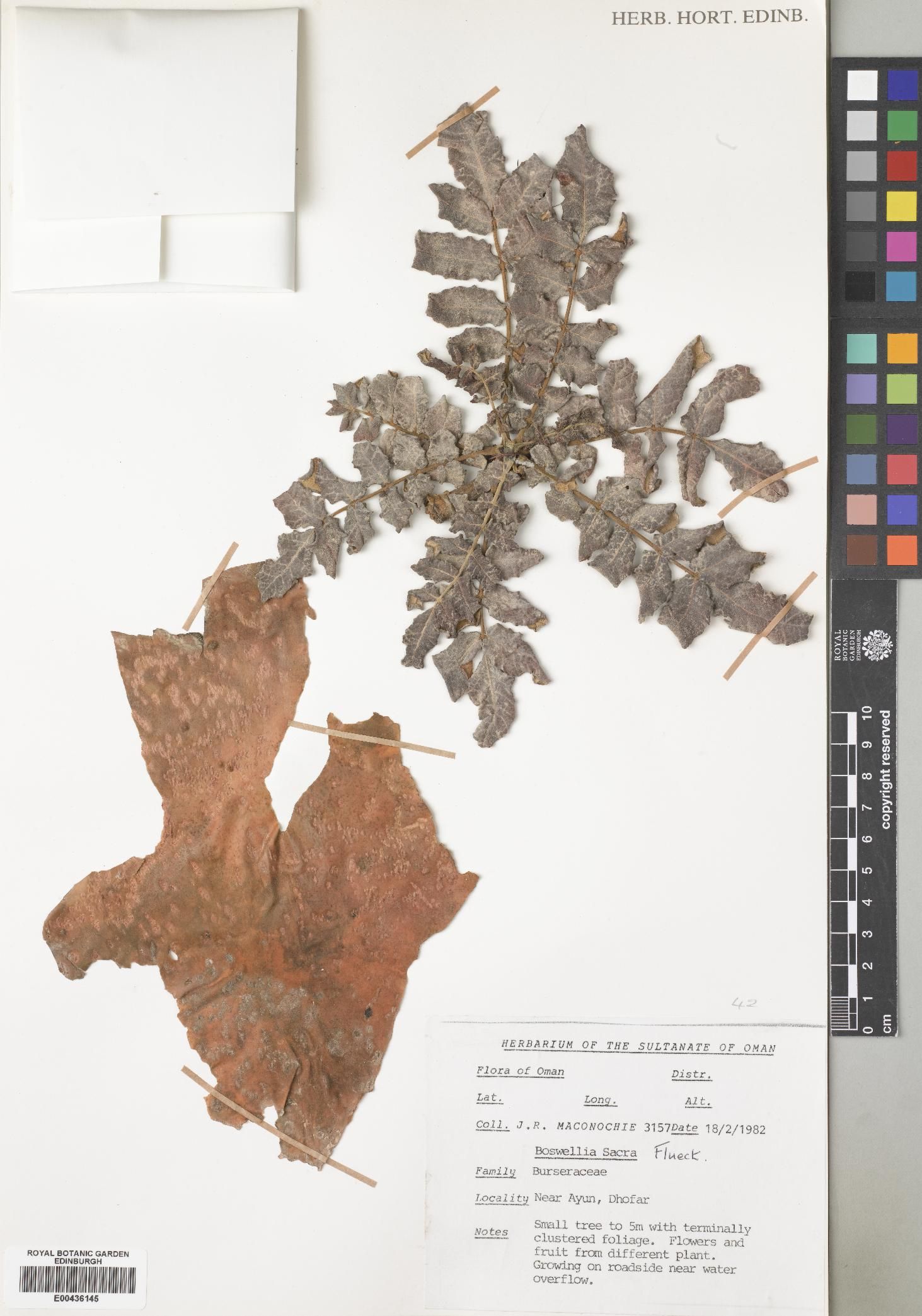
This family is a source of fragrances; frankincense and myrrh are its most well-known products. Frankincense is an aromatic resin used in incense and perfumes, obtained from trees of the genus Boswellia. Some unravelling of the origins of commercial and biblical frankincense has been captured in this blog by our colleagues at Kew.
The family Burseraceae is part of the order Sapindales. Recent molecular phylogenetic studies have shown that the families Anacardiaceae and Burseraceae are sister groups in Sapindales after having been separated in different orders for a long time. Anacardiaceae and Burseraceae are traditionally distinguished by the number of ovules (1 vs. 2) per locule and the direction of ovule curvature.
The family was named after the Joachim Burser (1583 – 1639). Burser was a German physician who moved to Denmark in 1625, where he became professor of botany and medicine at the Sorö Academy. Burser made extensive journeys throughout Europe in search of plant specimens which he arranged into a Hortus siccus, i.e. a collection of dried plant specimens. Many of the plants he discovered he sent to Kaspar Bauhin, who used them for the composition of his Pinax Theatri Botanici (1623). Burser’s 25 volume book found its way to Uppsala where it was studied my many Swedish botanists including Carl Linnaeus himself. It is currently housed at the Uppsala Botanical Museum, but the 2nd and 5th volumes are missing; they were lost in a great fire in Uppsala in 1702.
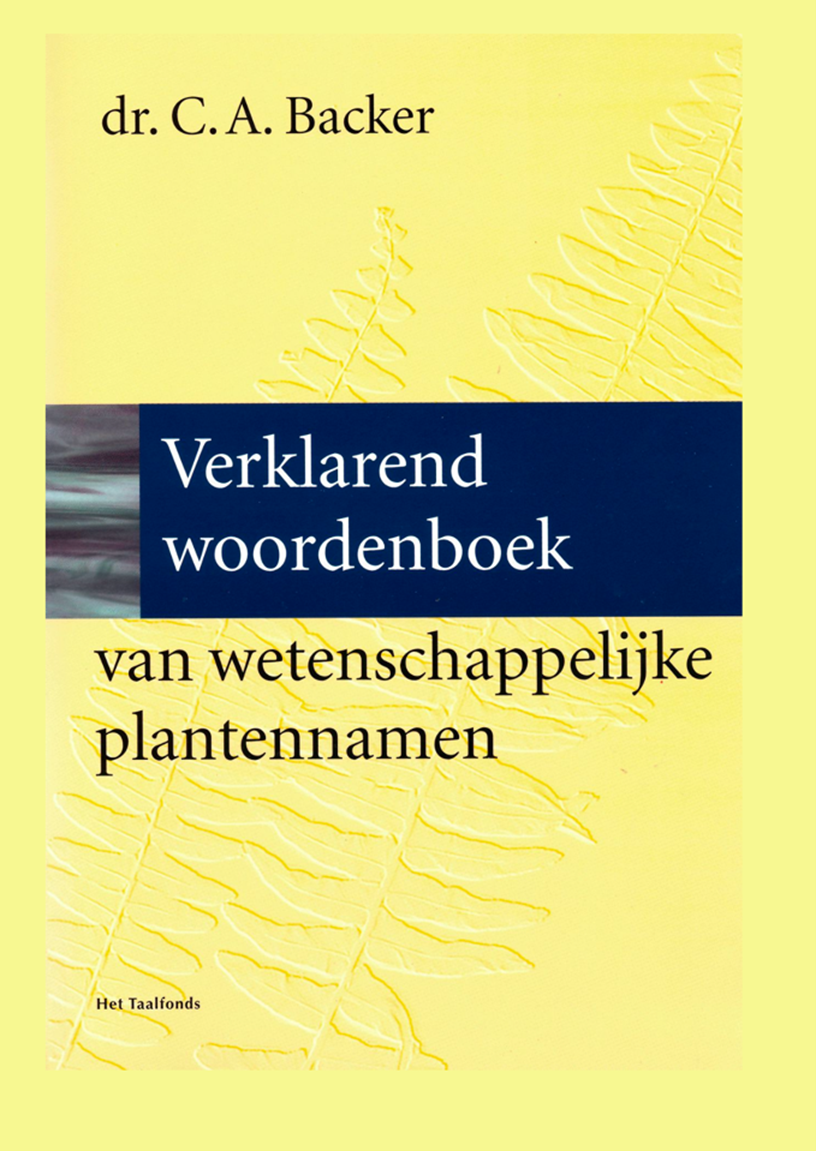
For more information about plant names and interesting, humorous bite-sized anecdotes about plant collectors, I can recommend the freely downloadable:
Verklarend woordenboek van wetenschappelijke plantennamen, by C.A. Backer and N. van der Sijs (ed.). It was written in Dutch and originally published in 1936. Translation software may reveal some of the vast and specific knowledge C.A. Backer collected during a lifetime of plant research. For many, the internationally recognized scientific names of plants are incomprehensible and unpronounceable. This prompted Dr. C.A. Backer, a former teacher and pioneer of Indonesian botany, to create a card index of scientific genus and species names, which, due to its continuous growth, was dubbed the “Tape Worm.” Under pressure from his colleagues, this unique reference work was published in 1936, providing the meaning, derivation, and pronunciation of approximately 22,500 names of Dutch and Indonesian flowering plants and ferns. Many plants are named after discoverers, growers, politicians, and mythological figures. According to the book’s foreword (and I can vouch for it) Backer provides concise biographies of approximately 2,700 of them, sometimes with exceptionally critical or humorous details. It is a fun book to dip into, and it would translate well.
Our collections
We now have a total of 1,694 Burseraceae specimens in our online catalogue – before mass digitisation we had 686 specimensto our database. Of these 96 specimens are types. Our Burseraceae specimens can be viewed here.
Top 5 regions
| No. of Specimens | Herbarium Filing Region |
| 303 | West Asia: Arabian Peninsula |
| 254 | Malay Islands |
| 179 | East Tropical South America |
| 170 | Tropical Africa |
| 121 | India, Bangladesh & Pakistan |
Top 5 Genera
| No. of Specimens | Genus |
| 356 | Canarium |
| 349 | Commiphora |
| 274 | Protium |
| 214 | Boswellia |
| 132 | Bursera |
The genus Canarium is well-represented in our collection. Canarium species tend to occur in Southeast Asia, Malaysia, New Guinea and Madagascar. An estimated 30 Canarium species occur in Madagascar, some of which are endemic. We only have two different species originating from there: Canarium paniculatum Benth. ex Engl. and Canarium madagascariense Engl., therefore our collection might benefit from having more Canarium species from that part of the world.
We do not have any representatives of the genus Rosselia. This genus only includes one known accepted species and is endemic to New Guinea, so it is not surprising we do not have it in our collection.
Interesting Specimens
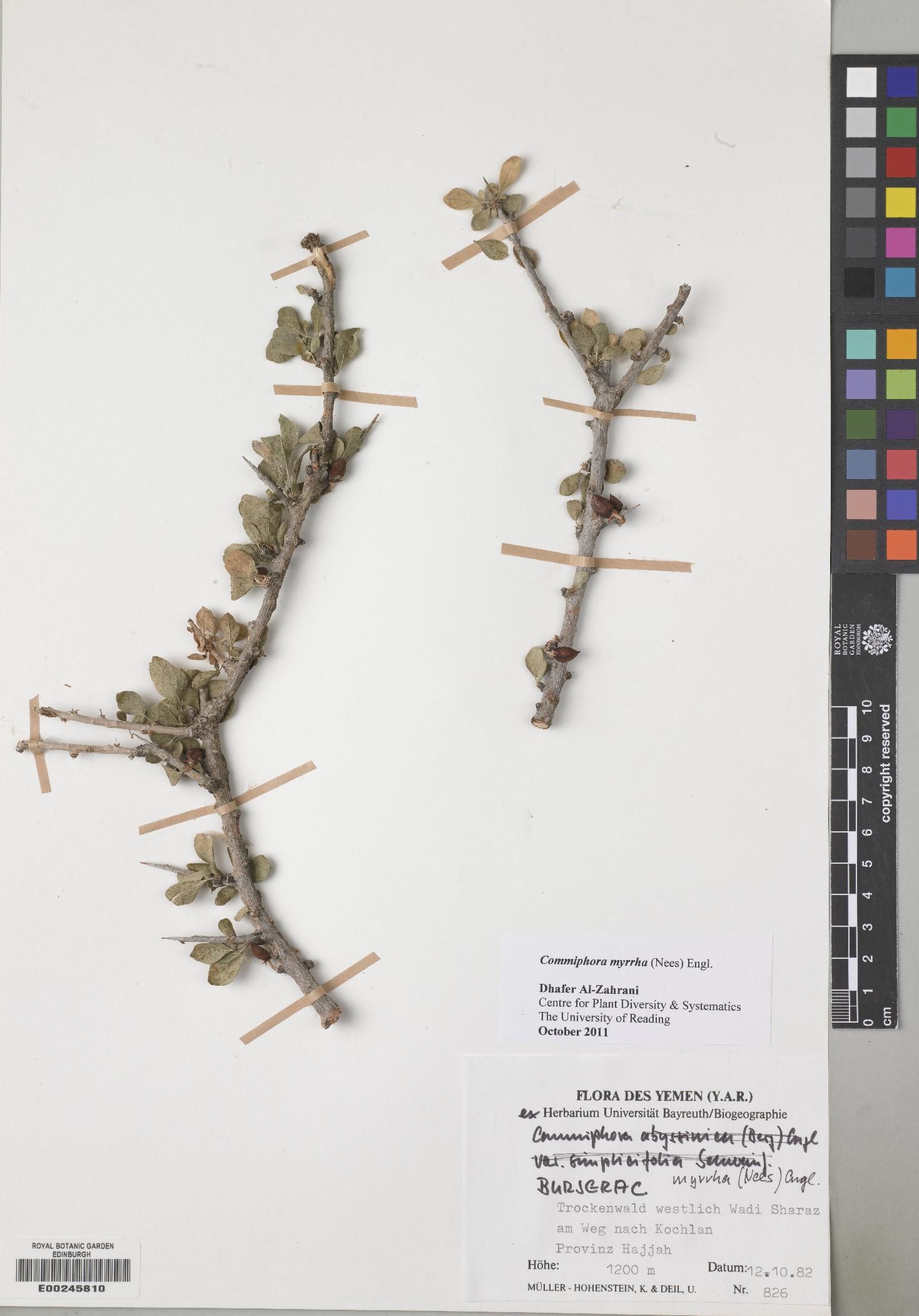
Myrrh is the solidified fragrant resin from Commiphora branches; it features in ancient myths and folktales. According to an ancient Egyptian myth the soul of the murdered Osiris lived on in the bird Bennu (also known as the Phoenix in later Greek mythology). This magical bird embalmed its father’s ashes in an egg of myrrh and carried it to the temple of sun god Horus at Heliopolis to be buried.
From ancient times up to the Middle Ages, myrrh was commercially important commodity. It was used in cosmetics, perfume, medicinally, and in embalming. Nowadays it is of less commercial importance, but it is still used in some toothpastes and perfumes. Its oil does not leave stains on textiles, and it is therefore useful in the perfume industry.
Early in 1880, Isaac Bayley Balfour led the first major botanical expedition to the biodiverse Yemeni island of Socotra. Socotra has a rich biodiversity with a distinct flora and fauna: 37% of Socotra’s, 90% of its reptile species and 95% of its land snail species do not occur anywhere else in the world. Bayley Balfour was Professor of Botany at Edinburgh University, and from 1888 onwards Regius Keeper of the Royal Botanic Garden in Edinburgh. The researchers in that first expedition identified over 200 plant species that were previously unknown to science. Nineteen Burseraceae specimens in our collection were collected during that 1880 Socotra expedition.
The distinctive cultural and natural heritage of the region was recognised by the prestigious World Monuments Watch as one of the world’s most priceless cultural and natural assets, and inclusion on the list will raise awareness and provide new opportunities for long-term and sustainable conservation of the region’s heritage. You can read more about our current links with Socotra and its selection for World Monuments Watch 2022 here.