The following blog was written by Becky Camfield a digitiser in the Herbarium.
Since 2021 we have increased our digitisation capacity reaching 1 million specimens imaged in August 2024. Each digitiser is assigned a family of plants to work through. This series of blogs will spotlight the families that have been completed by a member of the team.
The box family (Buxaceae) is a small family of now 6 genera and approx. 120 species. APG IV included Didymelaceae and Haptanthaceae within Buxaceae. They are shrubs or small trees found in Europe, Africa, Southern Asia, the United States, Central America, and northern half of South America.
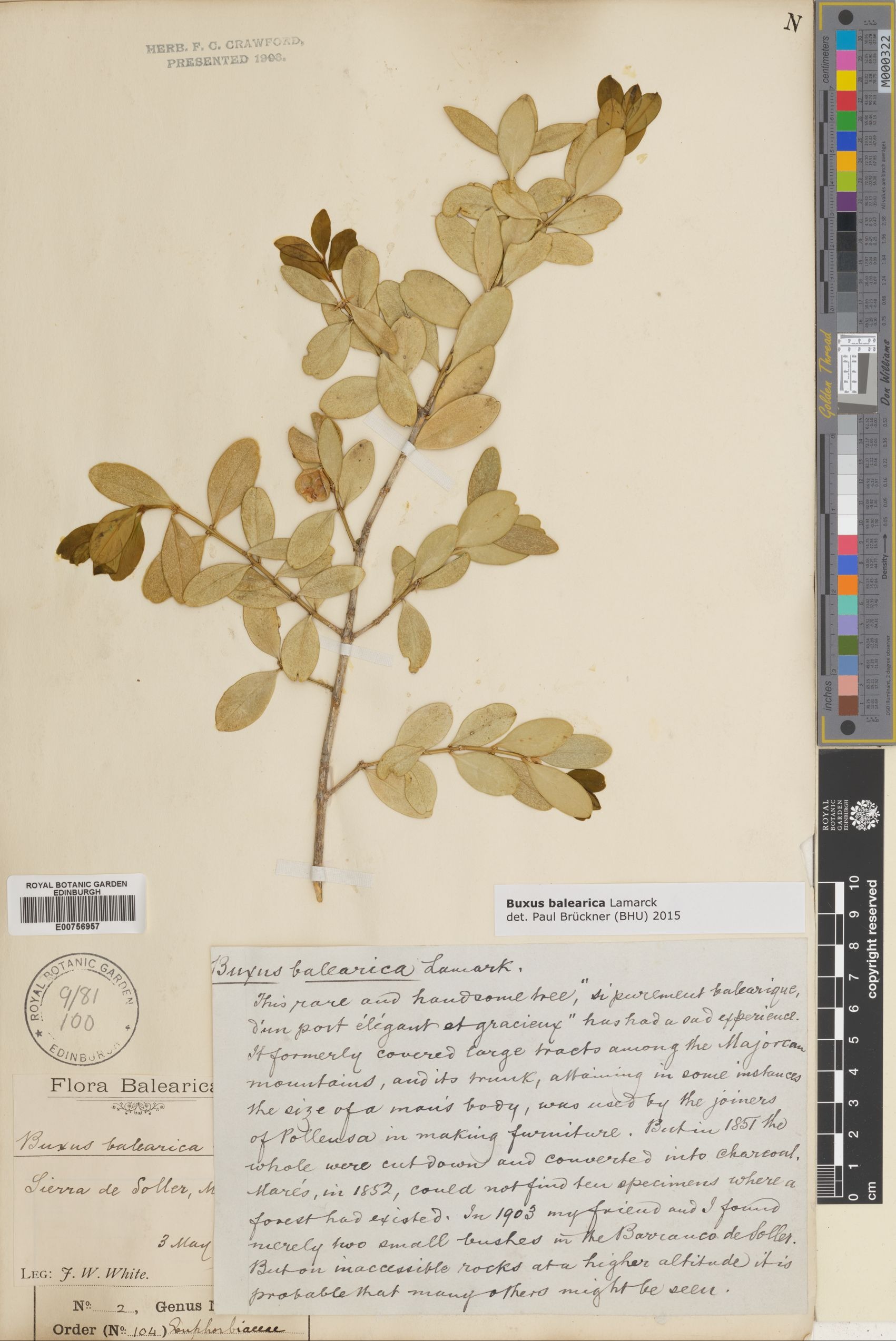
Buxus has approx. 70 species with a few centres of diversity; Cuba with 30 species, China with 17 and Madagascar with 9. It can be split into 3 groups. The Eurasian species, the African & Madagascar species and the American species. The latter two being the genetically closest.
They are primarily known in the UK for box hedging and topiary in gardens. Buxus also produces good wood for carving and due to its density and is often used for chess pieces. Its fine end grain makes it suitable for woodblock printing and woodcuts. Its wood is also used to make instruments in particular the tailpieces, chin rests and tuning pegs in string instruments. In the woodwind sections it was used for recorders and was a traditional wood for bagpipes before tastes turned to dense tropical woods such as ebony. Before plastic boxwood was used to make tools such as measurement scales, technical drawing rulers, set squares, yardsticks due its stability, yet also used in general functional items such as combs and weaving shuttles. In the UK, Europe and America it now suffers from an invasive moth (from Asia) whose caterpillars damage the plant. It is also at risk from boxwood blight, a fungus that causes defoliation and death. The fungus can affect other members of the family as well.
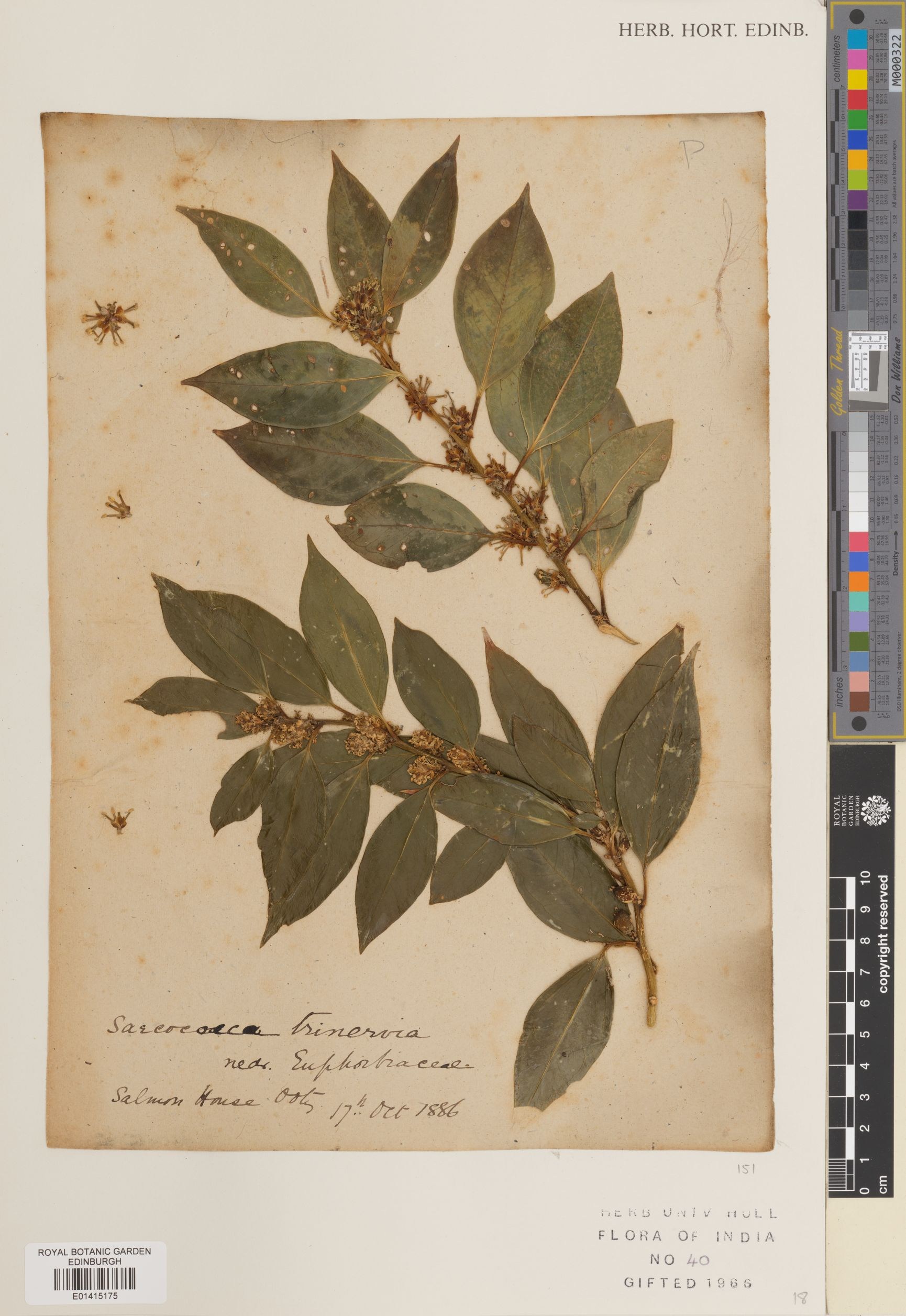
The genus Sarcococca is mostly from Asia with 15 species but does have 1 species in Mexico (S.conzattii ). They are grown mostly for their heavily scented flowers that arrive in winter/early spring giving them the name Christmas or sweet box.
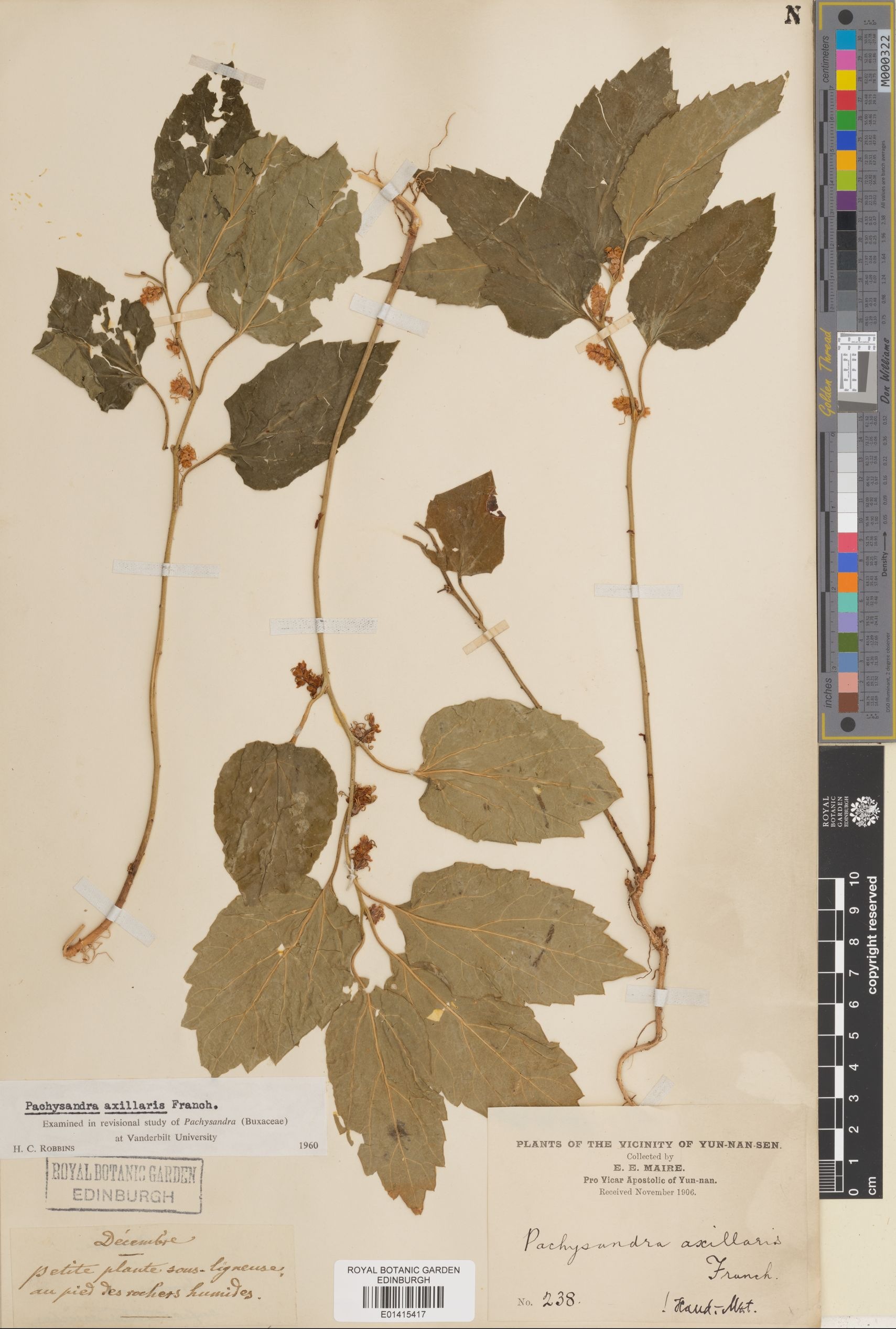
Pachysandra is also found in Asia and North America yet only has 3 species. They are primarily used as ground cover plants in shade gardens. They are sometimes referred to as spurge or in the case of P. terminalis Siebold & Zucc., carpet box as it’s only 10cm high.
Styloceras is native to Western South America, with 6 species found in the Andes of Colombia, Bolizia, Peru and Ecuador. Didymeles is endemic to Madagascar and the Comoros, with 3 species of evergreen trees.
Hapatanthus is monotypic and endemic to Hondurus. It’s one species H.hazlettii Goldberg & C.Nelson has a unique inflorescence structure. A singular female flower with no petals or sepals and either side of this female flower are two branches that carry 5 or 6 male flowers. Very few have been found in the wild.
Our Collections
Before mass digitisation projection we had 386 databased specimens. The project has doubled those available with now 855 being online, of which 26 are type specimens. Our collections can be viewed here.
Top 5 regions
| No. of Specimens | Herbarium Filing Region |
| 310 | Inner China, Taiwan and Korea peninsula |
| 106 | India, Bangladesh & Pakistan |
| 89 | Nepal |
| 63 | Cultivated |
| 60 | Europe (excluding Britain & Ireland) |
Top 5 Genera
| No. of Specimens | Genus |
| 416 | Buxus |
| 302 | Sarcococca |
| 82 | Pachysandra |
| 2 | Styloceras |
Our collections are low for Africa (32) and the Americas (19) yet considering our historic collection range is unsurprising.