
Alongside printed works the Library Collections at the Royal Botanic Garden Edinburgh hold a vast number of illustrations in different media. Many of the illustrations are original artworks. Historically the illustrations have played a supporting role to RBGE’s main tasks, the identification and classification of plants. However, over the last forty or so years, mainly with help from volunteers and student interns, original artworks have gradually been removed from main collections and brought together.
In recent years this work with RBGE Library illustrations collections has received significant help from student interns studying history of art at the University of Glasgow.
In early 2026 Carolyn Cusmano, came as a placement student from the University of Glasgow. Here is Carolyn’s account of her work with some of the art collections.
Teaching Diagrams: Exploring Botanical Collections During My Placement at the Royal Botanic Garden Edinburgh Library and Archives
Long before digital projectors and PowerPoint presentations, botany was taught at the Royal Botanic Garden Edinburgh through the incorporation of teaching diagrams. Now held in the Library and Archives, these diagrams range from hand-painted to commercially made, depicting a wide variety of plants. As an Art History master’s student at the University of Glasgow, during my placement (January-March 2026) at the RBGE Library and Archives, I was fortunate enough to work directly with a number of these teaching diagrams.
During the 18th and early 19th century, botanical lectures were held in the upper story of a building known as the Botanic Cottage. This building was originally part of RBGE when it was at Leith Walk. Botanic Cottage was transferred and re-built at the current RBGE location and opened for public engagement work in 2016.
The integration of art used for instruction in a scientific context raises questions about both the stylistic qualities of the teaching diagrams and their role as visual aids. My placement allowed me to explore these questions further, as prior to my time at RBGE, I had not fully considered the important role visual culture played in the history of scientific teaching.
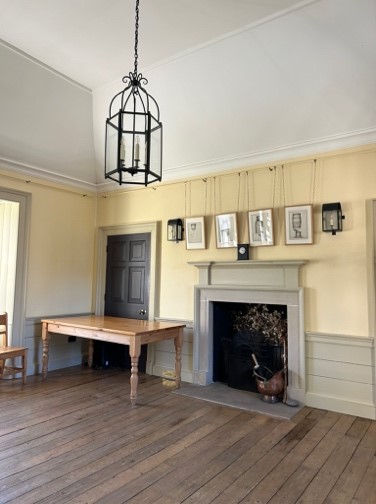
When Botanic Cottage was at Leith Walk, around 1,000 students were taught botany there, and many of the lectures integrated teaching diagrams.
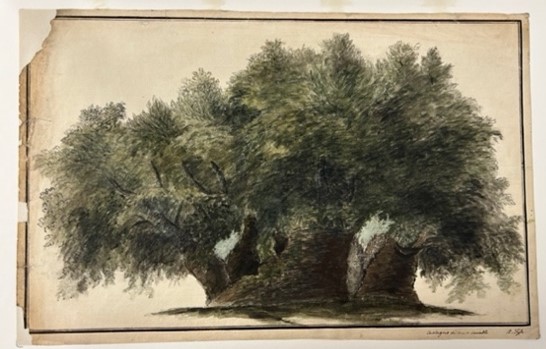
The first to teach botany at Botanic Cottage and use teaching diagrams, was John Hope (1725-1786), Regius Keeper and Professor of Medicine and Botany at the University of Edinburgh. Most of the diagrams used by Hope were drawn by his students and assistants, including Andrew Fyfe (1752-1824).
After the garden moved to its current site, John Hutton Balfour (1808-1884), Regius Keeper and Professor of Botany and Medicine at the University of Edinburgh from 1845 and 1879, re-introduced the use of teaching diagrams in his lectures.
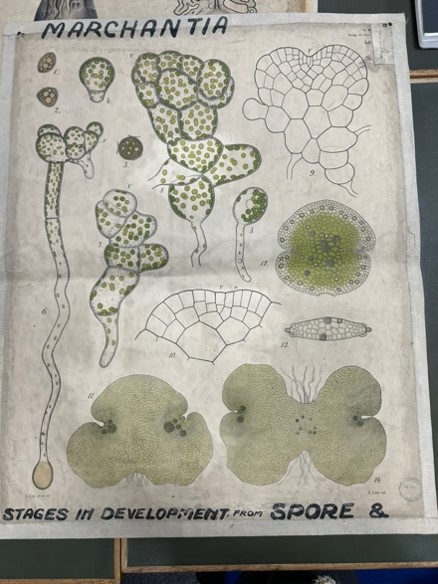
Yet, my time at RBGE began with the works of Matilda Smith (1854–1926), an artist well known for her detailed botanical works produced for Kew Gardens. Her illustrations served as an introduction for me to become familiar with cataloguing and data entry. This is a small collection, with no information attached as to how the works ended up at RBGE.
Through examining the illustrations closely with a magnifying glass, I identified materials, such as pencil and watercolour, while also recording inscriptions and measuring the works. In this initial stage of the placement, I also learned how to use World Flora Online, a botanical database used to identify plant species and families. Thus, this experience with the Matilda Smith collection prepared me to begin working with the John Hutton Balfour teaching diagrams collection, which became the central focus of my placement.
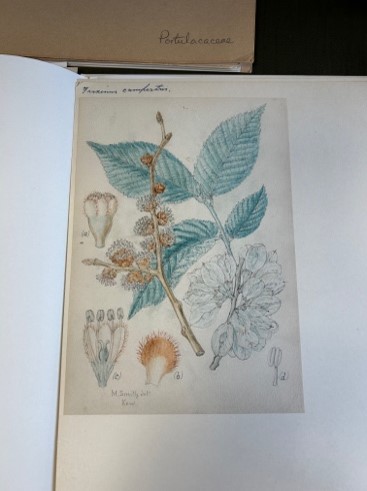
John Hutton Balfour used both nature-adapted and hand-drawn diagrams in his lectures, with artistic approaches ranging from stylized to detailed. The artist(s) of this collection are unknown. With Balfour also came the use of commercial diagrams with the advances of printing techniques. Some teaching diagrams displayed physiological experiments and the development of plant structures. Hand-drawn diagrams were adapted both from nature and printed sources and were useful for articulating small details. In showing physiological processes, teaching diagrams offered what was not possible with the real plant – to show it in different stages simultaneously, and to teach about plants out of season, not located at RBGE, or plants that were not transferable to the classroom. However, many teaching diagrams were stylized and not exact, because the overall objective was for the works to help develop observational techniques. Thus, teaching diagrams served as the most efficient visual method in botany education at this time, where they taught students how to observe the plant portrayed, train their “botanical eye”, and understand how to identify plants. These are all key reasons explaining why Balfour included the works in his lectures.
I spent most of my time during the placement carrying out data entry and basic condition reporting for John Hutton Balfour’s diagrams, where I identified small details to log in Excel – such as distinguishing handwriting, as well as measuring the works. Yet by working so closely with this collection, I was able to examine some other diagrams used by John Hope.
Next, I worked with my previous Excel catalogues to prepare and transfer the information regarding this collection into the digital archive (RBGE’s Digital Asset Management System). Part of the process involved reorganising information so it could be uploaded accurately, helping make the collection more accessible for staff and potential future public use.
My final project was creating a display for the RBGE Library and Archives staff and visitors. The display was titled Teaching Illustration, where I was able to highlight my favourite diagram from the John Hutton Balfour collection. This is the Pelargonium, or Geranium, teaching diagram. Alongside the object, I wrote interpretive text explaining both the historical purpose of the teaching diagrams and my own work with the collection during the placement.
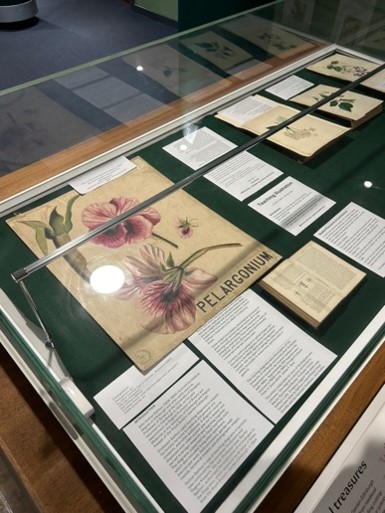
My hope in making this collection more visible to a wider audience is that the display will teach others how visual representations of plants were used as historical tools of education, research, and observation.
Thank you to the staff at the RBGE Library and Archives for their continual support throughout my placement, and for making this research possible.
Bibliography
- Bleichmar, Daniela. Visible empire: botanical expeditions and visual culture in the Hispanic Enlightenment. University of Chicago Press, 2019.
- Bucci, Massimiano. Images of Science in the Classroom: Wallcharts and Science Education 1850–1920. The British Journal for the History of Science 31, no. 2 (1998): 161-184.
- Crary, Jonathan. Techniques of the observer: On vision and modernity in the nineteenth century. MIT press, 1992.
- Fletcher, Harold R. and Brown, William H. The Royal Botanic Garden Edinburgh 1670-1970. Her Majesty’s Stationery Office, 1970.
- Forsyth, Sutherland. Discover the Botanic Cottage. Royal Botanic Garden Edinburgh, 2016.
- Morrow, Lorna. “Geographies of botanical knowledge: the work of John Hutton Balfour 1845-1879.”PhD diss., University of Edinburgh, 2018.
- Noltie, Henry J. John Hope (1725–1786): Alan G. Morton’s Memoir of a Scottish Botanist–a new and revised edition. 2011.
- Smiles, Sam. Eye Witness: artists and visual documentation in Britain 1770-1830. Ashgate, 2000.
- Rix, Alison. “Matilda Smith, her life and work for Curtis’s Botanical Magazine.” Curtis’s Botanical Magazine 41, no. 1 (2024): 131-145.
- Royal Botanic Garden Edinburgh. “Library and Archives.” Accessed April 30, 2026. https://www.rbge.org.uk/collections/library-and-archives/
