
During my work on the drawings made for Robert Wight by Rungiah and Govindoo I stumbled upon a reference to a collection of botanical drawings made in Madras several decades later for Mountstuart Elphinstone Grant Duff, Governor of Madras 1881–86. The point of greatest interest then was that in his diaries Grant Duff reported the name of his artist as Rungiah Raju, and that he was connected with Wight’s eponymous artist. This gave the previously suspected, but unproven, link between Wight’s Rungiah and the community of Tanjore artists who used the name Raju.
The three Grant Duff albums were sold at auction in 1982 and thereafter split up, but a few years ago someone got in touch with me who had found three of the drawings, framed but unattributed, in a garage in Belgium. Soon after my identification they were flogged off at Sotheby’s and made an astonishing £12,500. While the drawings were interesting enough, of plants in the garden of the Governor’s ‘Garden House’ at Guindy, and in the Nilgiri Hills around Ootacamund where the Governor had a summer residence, what was even more intriguing was that stuck on the back of one of the frames was a copy of Grant Duff’s bookplate. The then owner sent me a photograph of it and though in relatively poor condition it is incredible what ChatGPT can do to revive damaged images. Here is the result:
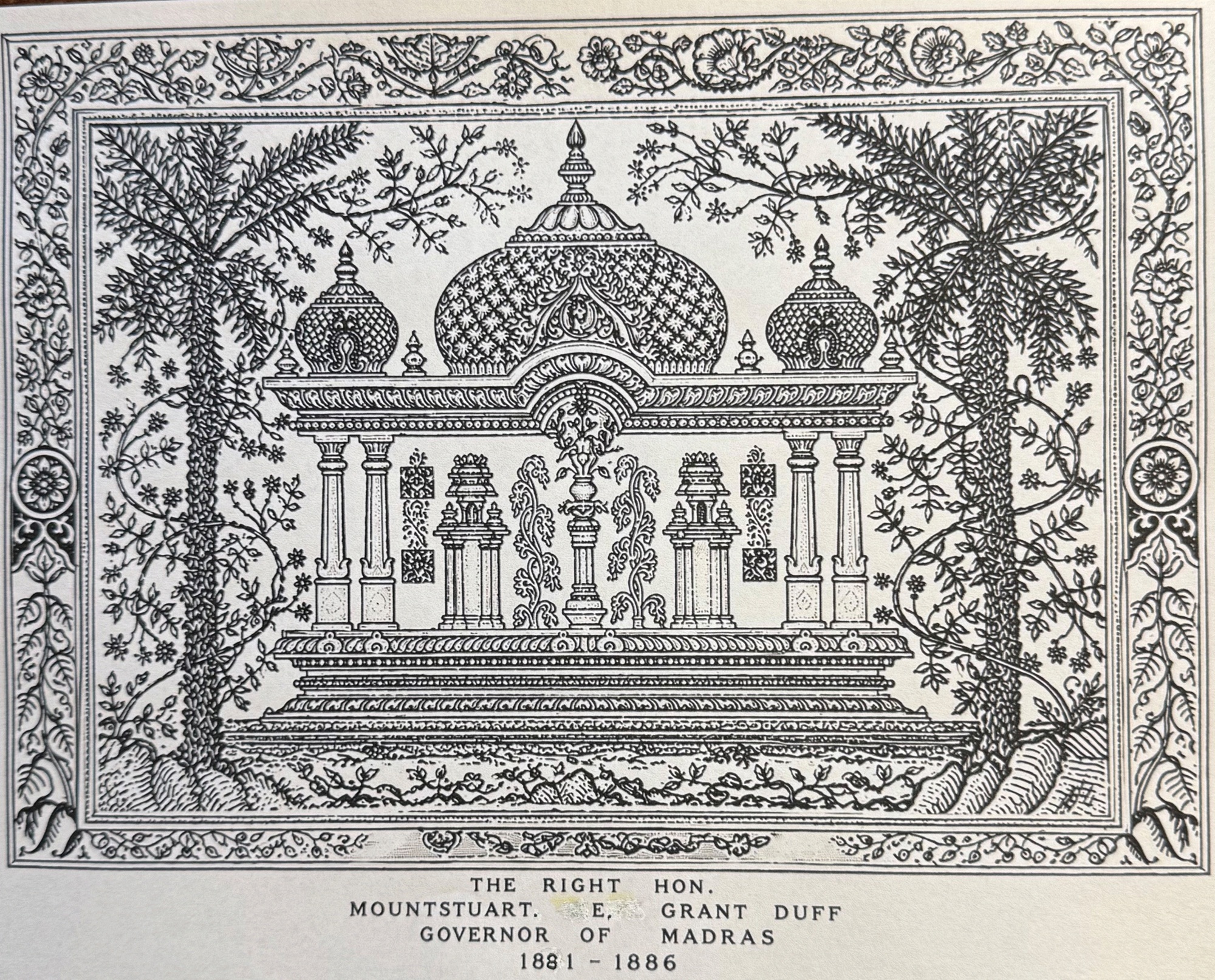
In his diary Grant Duff provides a detailed explanation of the commissioning and iconography of the bookplate. He wanted not the usual boring armorial sort, but one of personalised, emblematic meaning. So he consulted Ernest Binfield Havell, director of the Madras School of Art, who asked a sadly un-named ‘native draughtsman’, to turn a sketch into a finished work.
In the doctored image only the central emblem in the lower border has been badly misread by ChatGPT. In the original, as explained somewhat sententiously (if realistically) by its commissioner, is a ‘pen and scroll, crossed by a sword, to typify that we rule here by a mixture of force and policy’. The next layer above this shows a creeping plant of the Madras beach, Ipomoea pes-caprae, which has bilobed leaves on which its epithet ‘goat’s-foot’ is based. One does, however, have doubts about Grant Duff’s colour vision when he described its mauve-pink flowers as blue. The prostrate vegetation immediately below the plinth of the building is supposed to represent the sacred lotus, though why that majestic plant should be represented in such an inelegant and undignified horizontal position is mysterious. For the building Grant Duff declined responsibility, which he passed on to the School of Art, though representative of the syncretic ‘Hindu and Muhammadan architecture of South India’.
Two elements for which the Governor did claim responsibility was the pot of sacred basil (now Ocimum tenuiflorum) on the pillar in the centre of the temple/mosque ‘as it stands … in the courtyard of every Hindu house where Vishnu is venerated – forms, in fact, the domestic altar’. In a cartouche at the middle of the base of the central dome is perhaps the most curious feature of the whole composition. A tiny representation of ‘the coin of Claudius, struck to commemorate the conquest of Britain [AD 43], and found in the Madurai district of the British Empire’. This was to symbolise not only Grant Duff’s love of numismatics, but ‘the transfer of the centre of political gravity from the banks of the Tiber to the banks of the Thames’.
Four other plants remain to be described. In the border, top left, is the native passion flower Passiflora leschenaultii, ‘characteristic of our lives on the Nilgiris’. The leaves at the base of the borders on both sides represent the peepul, Ficus religiosa, ‘a glorious tree and holy all over India’. The flanking palm trees are the wild date, Phoenix sylvestris, ‘very common in this [Guindy] Park’, around which twine jasmine, deliberately stylised as Grant Duff knew of three species. While:
‘paying a visit to a great native noble … an inevitable incident of all such ceremonies is that one is engarlanded with a vast rope or boa, made from the flowers of one variety of Jasminum sambac, while Jasminum brevilobum is much with one on the Nilgiris; and I can there also obtain the North Indian Jasminum officinale … which happens to be the flower I like best’.
Henry Noltie
Leave a Reply