
This article was written by Lindis Kipp, Plants with Purpose PhD student in the Nature-Based Solutions team at RBGE.
How often do you really look at the trees you encounter daily? Many of us walk past single trees, small patches and larger parks every day as we go about our lives without giving the trees much thought. And yet they are closely intertwined with our living experience in ways we don’t necessarily notice straight away.
In summer, the shade from a street tree next to the bus stop is welcome respite from the heat; in autumn our children and dogs love to play in the piles of leaves. When it rains, we seek shelter and on a warm night the gentle rustle of leaves outside an open window can calm us and lull us to sleep. All of these are examples of only some of the ecosystem services trees provide for humans in cities: temperature regulation, flood mitigation and greenspaces for leisure and mental health.
There are many more benefits, summarised beautifully in this infographic by Treeconomics:
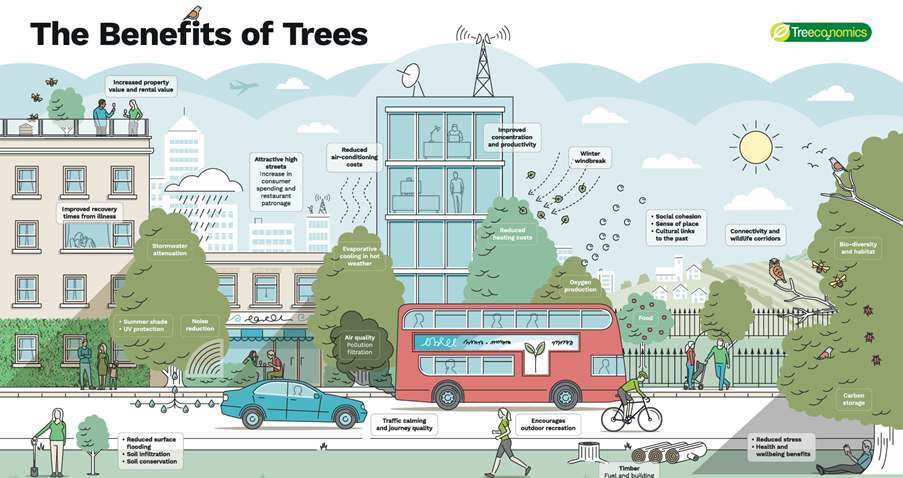
The many benefits of urban trees
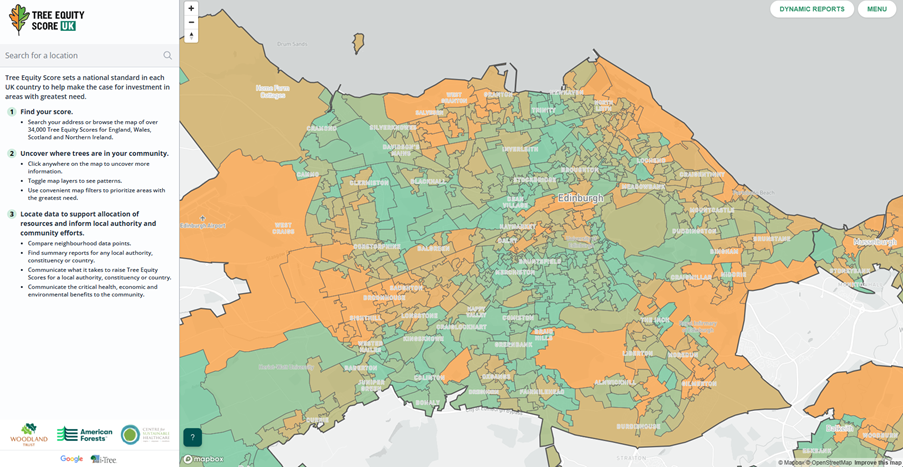
Planting trees and having sufficient canopy cover can decrease temperatures by up to 6 degrees Celsius in temperate cities; as global temperatures rise due to the climate crisis and we experience record summer heat year after year, this function becomes increasingly important. The distribution of trees in our cities is uneven and often mirrors socioeconomic inequalities, meaning the benefits of tree-related temperature regulation are not equally distributed.
Similarly, increased winter rainfall in both frequency and intensity can become problematic in cities with little capacity to soak this water up. Trees help to provide our urban landscapes with the ability to withstand these deluges by intercepting the water and helping to channel it into the ground more effectively.
At RBGE, our rain gardens have shown how effective plants can be at intercepting excess rainwater. There are many similar projects being implemented in cities across the UK, such as the Glasgow Avenues project, which combines tree planting and rain gardens.
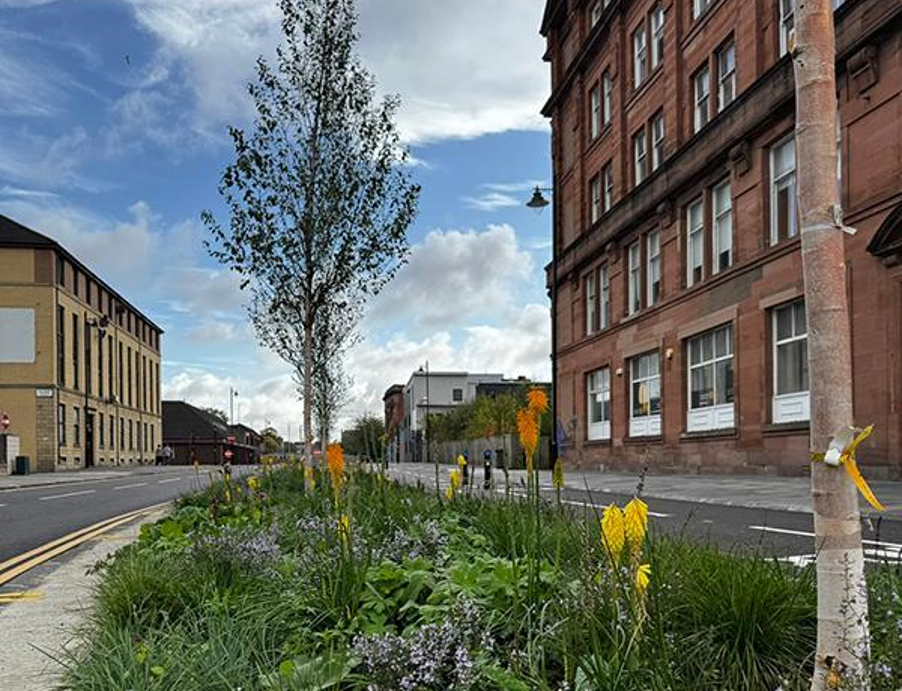
Urban forest as healthy connected ecosystems
All these benefits are fantastic reasons to protect existing urban trees and add new ones. However, climate impacts are not the only results of our global crisis: we are also facing devastating biodiversity losses.
While the biodiversity benefits of trees are often cited when tree planting is talked about, there is little evidence about the biodiversity contribution of urban trees. It is true for example that a single mature oak can support more than 2000 species; however, this depends heavily on the circumstances in which this oak is growing, including its connectivity to other habitat, its understorey and the availability of deadwood.
Many of these factors are in direct conflict with human co-existence: a large, dead branch is ideal for many fungi and insects, but a hazard for humans if it overhangs an area that is frequently used. An increase in winter storm frequency and intensity can lead to events like Storm Éowyn, with wide-spread damage from falling trees. A dense and varied understorey provides food and shelter for a multitude of animals, but it is difficult to walk through and can look “messy”. It is therefore important to find middle ground between what works for humans and what works for the rest of the natural environment, especially since the UK is currently not on track to meet the 2030 Global Biodiversity Framework targets.
My PhD research aims to address this problem. I will investigate the ecological health of urban woods and trees as well as their contribution to biodiversity and connectivity as part of the RBGE’s Plants with Purpose programme. The next time you are out and about in your city have a look around and try really seeing the trees – I know I will be!
Biography:
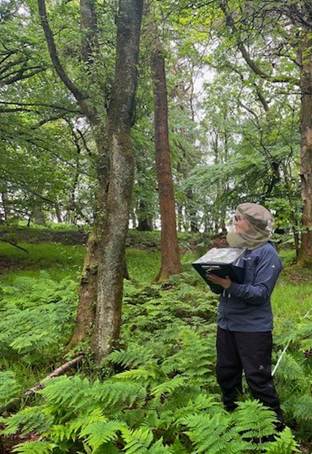
I am a PhD student at RBGE and the University of Stirling. My research is funded by the RBGE’s Plants with Purpose programme and the Scottish Forestry Trust. I recently graduated from Stirling with a BSc in Environmental Science and Outdoor Education. I am interested in designing and implementing nature-based solutions which can keep pace with the ecological impacts of climate change, as well as the pedagogical challenges of inspiring climate-positive action.
Leave a Reply