
The following blog was written by Linde Hess a digitiser in the Herbarium.
Since 2021 we have increased our digitisation capacity reaching 1 million specimens imaged in August 2024. Each digitiser is assigned a family of plants to work through. This series of blogs will spotlight the families that have been completed by a member of the team
This family consists of roughly 2000 species, its distribution is pantropical and extending north into Europe and Canada, and south into New Zealand and parts of Argentina and Chile. Found in tropical evergreen forest and in temperate regions in drier habitats, (source: POWO).
Citrus fruits are well-known members of this family; the genus Citrus is native to South-East Asia and Australasia but now grown worldwide.
The Food and Agriculture Organization of the United Nations (FAO) has a wealth of information about the worlds crops and says the following about citrus fruits: Citrus is one of the most popular and widely grown fruit crops in the world. Oranges account for more than half of world citrus production and are the most widely traded citrus fruit, followed by tangerines, lemons and grapefruits. World citrus production and export have grown steadily over the past three decades, although at a slower pace than competing fruits, such as mangoes, avocados, and melons.
Below there are two charts which give an indication of the size of the world tangerine/clementine/mandarin market. These fruits are lumped together as a commodity by the FAO. I won’t go into the taxonomy of the species, varieties, cultivars, and hybrids as it is complex and controversial. As far as I understand: a clementine (Citrus × clementina) is a hybrid between a ‘Willowleaf’ mandarin orange (C. × deliciosa ‘Willowleaf’) and a sweet orange (C. × sinensis). In the UK clementines are often marketed as Easy Peelers. Mandarins or mandarin oranges are Citrus reticulata Blanco.
The charts below show that Asia is the biggest producer of tangerines/mandarins/clementines, with China being the country with the greatest production: 27 million tonnes (in weight) produced in 2024. In Europe, Spain and Italy are the biggest producers, which makes sense with their citrus-friendly climates.
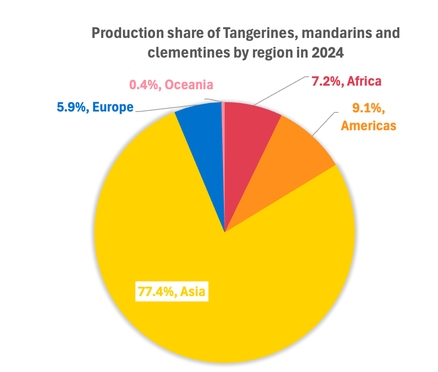
The FAO puts lumps these citrus fruits together as one commodity: mandarin, tangerine (Citrus reticulata); clementine, satsuma (C. unshiu) Source: FAOSTAT – https://www.fao.org/faostat/en/#data/QCL/visualize
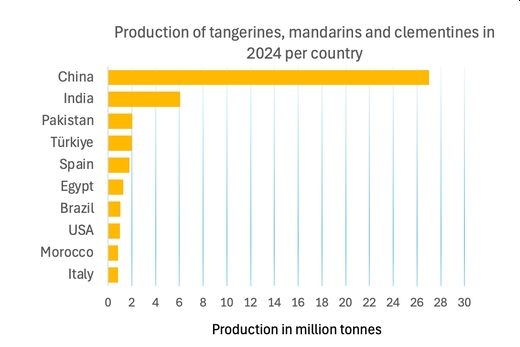
Source: FAOSTAT – https://www.fao.org/faostat/en/#data/QCL/visualize
Our Collections
Before mass digitisation we had 3,614 specimens digitised, following digitisation we now have 9,013 specimens in our online catalogue. Of these we 168 are type specimens. The collection can be viewed here.
Top 5 Genera
| No. of Specimens | Genus |
| 1,193 | Zanthoxylum |
| 497 | Haplophyllum |
| 429 | Boronia |
| 344 | Melicope |
| 327 | Skimmia |
Top 5 Filing Regions
| No. of Specimens | Herbarium Filing Region |
| 1,436 | Inner China, Korea and Taiwan |
| 1,271 | Australia |
| 847 | India, Pakistan & Bangladesh |
| 785 | Southern Africa |
| 475 | Indo-China |
Under represented regions and genera
We have no representatives of the small genus Decazyx Pittier & S.F.Blake; the native range of this genus is Mexico to Central America. Another small genus which is absent from our collection is Plethadenia Urb., this is not unexpected as it only occurs on Cuba, Dominican Republic and Haiti; locations where we rarely collect.
Interesting specimens
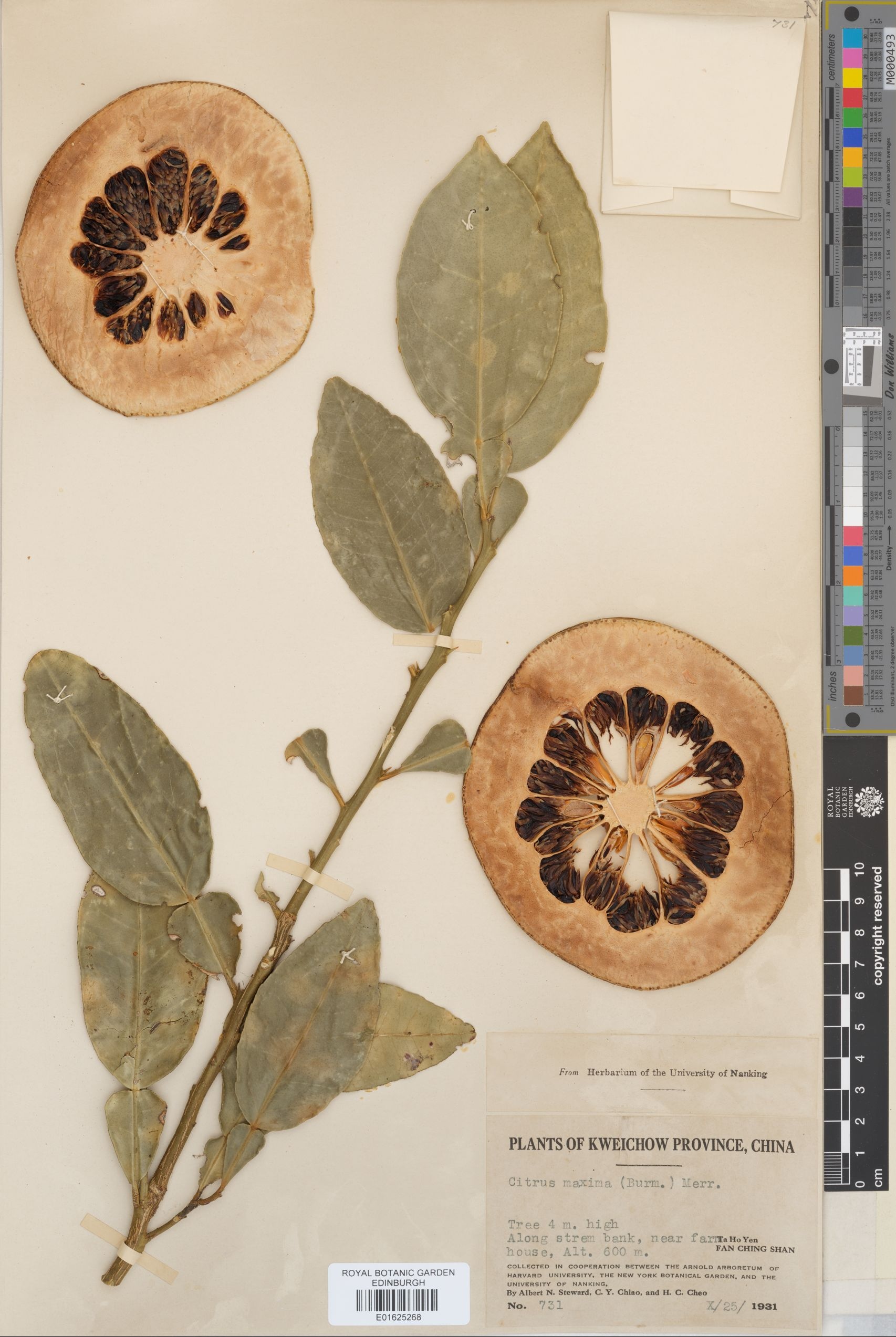
Below are two Rutaceae specimens which caught my eye, the first one, because it had big section on a pomelo fruit. The second specimen (Adenandra) had beautiful dots on the undersides of its tiny leaves. It is an evergreen shrub, commonly known as buchu. The genus is native to South Africa. The dots are oil glads which release a herbal fragrance.
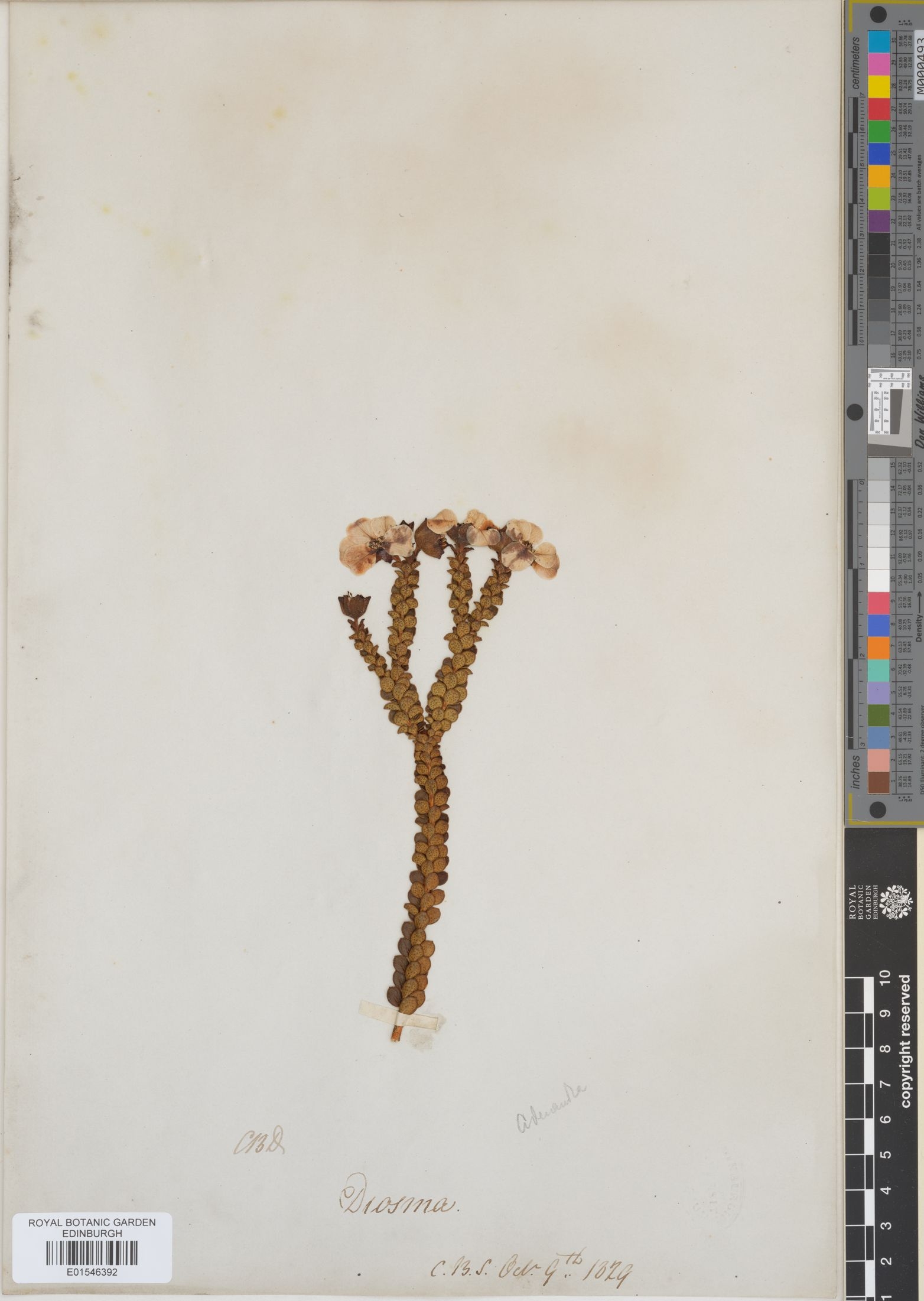
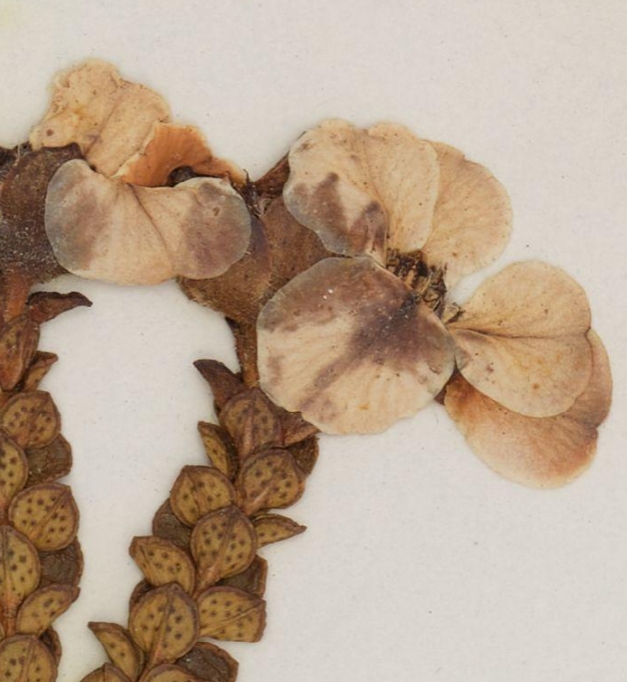
Specimen of Adenandra brachyphylla Schltdl. and a close-up next to it. It was collected in 1829 in South Africa (E01546392)
Leave a Reply