
The following blog was written by Natalie Zarte a digitiser in the Herbarium.
Since 2021 we have increased our digitisation capacity reaching 1 million specimens imaged in August 2024. Each digitiser is assigned a family or group of plants to work through.
Every now and then, you come across an adventurous lichen.
This specimen of Rinodina oleae Bagl. was collected by P.M. Earland-Bennett at Tree island, Leigh on Sea in May 2005 (E01544879). However, the substrate it had chosen to grow on, is not a stationary piece of rock, nor a sessile tree. It had grown on an old wooden boat, just above the high water mark. R. oleae is most commonly found on nutrient rich rocks and prefers a shadier place to grow, with less than 40% of light exposure.
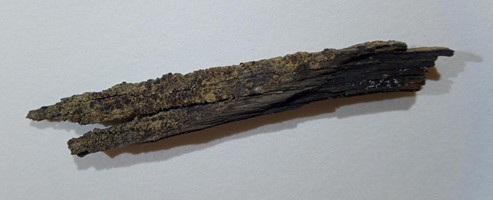
However, lichens are generally very adaptable and resilient and manage to thrive in extreme conditions. They have developed several adaptations over time, which allow them to survive in harsh environments, when other organisms would not. To the dismay of most sailors, lichens are exceptionally good at surviving in the nooks and crannies of their vessels, even if they are temporarily submerged. Without roots, lichens absorb water and nutrients from their environment via air or in this case, what washes over them.
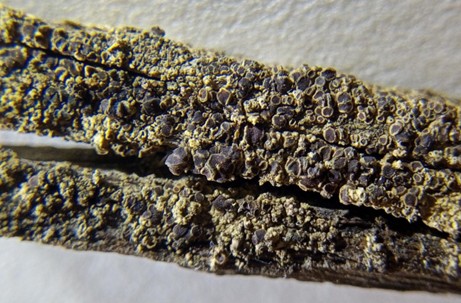
Rinodina oleae is a crustose lichen, this means (yes you guessed it), it has a crust-like appearance. This type of lichen is growing tightly along its substrate at a slightly slower pace of an average 1cm growth per year! R. oleae is whitish grey to pale greenish grey in appearance.