
Alongside printed works the Library Collections at the Royal Botanic Garden Edinburgh hold a vast number of illustrations in different media. Many of the illustrations are original artworks. Historically the illustrations have played a supporting role to RBGE’s main tasks, the identification and classification of plants. However, over the last forty or so years, mainly with help from volunteers and student interns, original artworks have gradually been removed from main collections and brought together.
In recent years this work with RBGE Library illustrations collections has received significant help from student interns from Edinburgh College of Art.
The connections between Edinburgh College of Art and the RBGE reach back to the early twentieth century when the ECA was given its present name and moved to its current site. RBGE also played a part in the story of the predecessor art schools of ECA, but that story can wait. In this blog we are interested in current collaboration.
In early 2026, ECA students, Leo Dakin and Tory Irmeger inventoried, checked through and researched a collection of early nineteenth century paintings of trees and shrubs.
In this ‘Botanics Story’ Tory tells us something about these artworks.
Botanical Illustrations from Watson’s ‘Dendrologia Britannica’ (1825)
It is not known exactly when this collection of watercolor drawings of trees and shrubs came to the Royal Botanic Garden Library, except that they were discovered upon moving the collections to the current library facilities in 1964.
These drawings were made in the early nineteenth century by four artists: J. Hart, Edwin Dalton Smith, Mrs J. Travis, and Sarah Travis. They appear in Peter William Watson’s richly illustrated 1825 publication Dendrologia Britannica, or Trees and Shrubs that Will Live in the Open Air of Britain Throughout the Year.
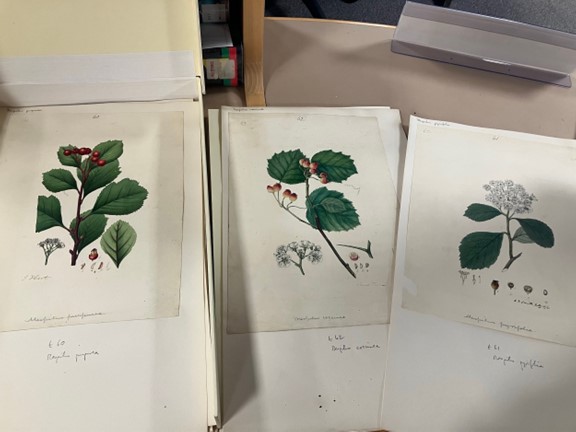
Dendrologia was originally published monthly beginning in January 1823, each part containing eight colored plates drawn from living trees and shrubs in the London vicinity. An expanded bound edition was published in two volumes in 1825, containing a total of 172 coloured plates. The Library contains 156 of these drawings, which were at some point mounted on herbarium sheets. Seven of the other drawings are in the John Ruskin collection at the Ashmolean Museum, an interesting connection which we will return to later.
Dendrologia was a notable addition to English-language botanical literature for its focus on the study of trees. Watson, a founder of Hull Botanic Garden, presents it as such in his introduction to the text: “Considering the present advanced state Botany, it seems extraordinary that no person, in our country, since the time of [John] Evelyn…should have taken up, in a special manner, the Dendrologic Department of the science.” Nineteenth-century taxonomists were eager to classify exotic plants entering Britain from around the world, and Dendrologia is no exception. Tables accompany each botanical illustration with descriptions of plant parts, time of blooming, native region, and where the illustrated specimen was located. Many of the specimens included had been gathered via colonial connections throughout North America and Asia to be cultivated by enthusiastic botanists and gardeners in Britain.
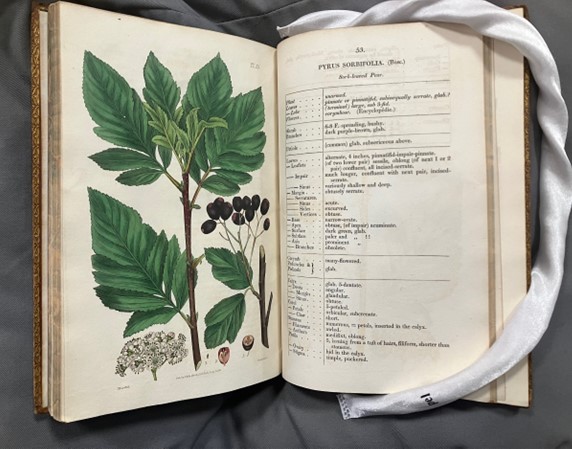
Who were the artists of Dendrologia? Edwin Dalton Smith and J. Hart carried out a majority of the illustrations. Around 52 are attributed to Smith and 90 to Hart. Very little is known about Hart, even his first name, but we know he worked with Smith again on another botanical publication shortly after, Robert Sweet’s British Flower Garden (1823-34). As for E.D. Smith, he was born in 1800 in London to a well-known engraver and miniaturist Anker Smith. There were several artists in the Smith family, including Edwin’s brother-in-law John Cart Burgess (1798-1863) who was a talented watercolor artist of flowers and fruits and published drawing manuals on the subject. Later, E.D. Smith would move to miniatures and photography, but he began his career specializing in botanical illustrations. His work was widely published by Robert Sweet, including British Flower Garden as well as Flora Australasica (1827-28) and Geraniaceae (1820-30).
Two women also contributed several illustrations to Dendrologia: a Mrs J. Travis and Sarah Travis. Unfortunately, very little is known about these artists. From their names, we can surmise a possible relation, but this is not known. It’s likely they were based in or near London, as this is where the specimens for the illustrations were sourced. Women in the nineteenth century were encouraged to study botany, although sometimes their contributions were obscured or published anonymously. Nevertheless, the works by Mrs Travis and Sarah Travis are integral contributions to Dendrologia.
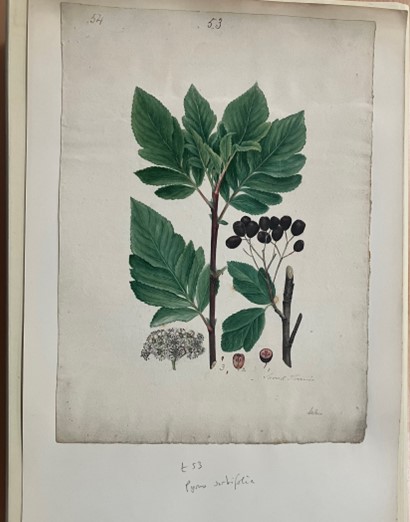
Despite some ambiguity surrounding the artists, the Dendrologia illustrations provide a meaningful insight into the relationship between artistic and taxonomic conventions in this period. Watson, like many of his contemporaries, favored the Linnaean system of plant classification, a taxonomy that paid particular attention to flowering and reproductive parts of plants.[1] Stephen Daniels et al. suggest that this is one reason Dendrologia drawings show only flowering and fruiting branches, rather than full-length illustrations which would be far more useful to the reader in grasping the full characteristics of the trees and shrubs.[2] The dissections in the illustrations further cement this work as taxonomical literature, showing tiny details and cross-sections of fruits, seeds, and flowers.
The drawings held at the Ashmolean Museum, Oxford
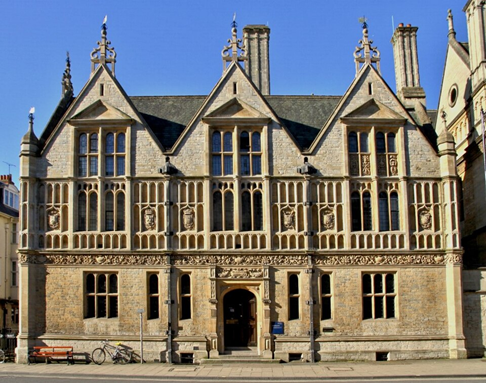
Returning to the seven associated drawings in the Ashmolean Museum, these found their way to John Ruskin in the latter half of the nineteenth century. Of these seven drawings, three are by artists Mrs J. Travis, one by E.D. Smith, and three by J. Hart, and they correlate to Plates 27, 52, 89, 90, 97, and 159 of Dendrologia. From Ruskin’s catalogues, we know these drawings were part of his teaching material at his drawing school in Oxford, and they were gifted to him by a pupil for this purpose, presumably around the time of the school’s founding in 1871.[3] The seven Dendrologia drawings were categorized in a cabinet among other plant and tree drawings, which students could access for lessons. Ruskin attributed all seven of the drawings to J. Hart, and it is not certain whether he knew of the connection between these artworks and Dendrologia. He praised the coloration of the drawings, but critiqued “the constant English fault of mechanical precision instead of design.”[4]
John Ruskin had a strong interest in natural history, but his perspective was informed by a literary and artistic disposition that sometimes took precedence over contemporary botanical conventions.[5] In the fifth edition of his Rudimentary Series, a teaching catalogue for students outside the University, Ruskin entered a lengthy tutorial on how to recreate an illustration of the daffodil (Narcissus). This entry is associated with an engraving “Narcissi” appearing in Jane Loudon’s publication The Ladies’ Flower-Garden of Ornamental Bulbous Plants. In his instruction, Ruskin first encourages students to practice close observation as they prepare to outline and color the parts of the plant, for he says,
“It is just as difficult, nevertheless – (and you had better begin discouraged by knowing this, than fall into discouragement by discovering it,) – it is as difficult to outline one of these Narcissus petals as to outline a beautiful ship; and as difficult to outline the Narcissus cup as a Greek vase; and as difficult to outline the Narcissus stalk as a pillar of the Parthenon.”[6]
If a student were to inspect the other cabinets in the Ruskin school, they would indeed find Italian architecture and ceramic objects as exemplars to draw from. Positioning ‘Narcissi’ among these classical materials reveals the esteem in which Ruskin held botanical illustration for his students. His instruction in this passage is not to discourage students from the difficulties of botanical drawing, but rather to hone their attention to the details typically skipped over in day-to-day interaction. He also discouraged the popularity of photography, which in his day had “introduced a morbid and exaggerated love of effects of light.”[7] Whereas, in his view, the painter can reproduce such effects to a greater skill with a bit of practice.
The legacy of Watson’s Dendrologia
This brings us to the legacy of Watson’s Dendrologia. It is not the most known English-language text on arboriculture, a distinction which would go to John Claudius Loudon’s Arboretum et Frutiecetum Britannicum. John Loudon, husband of aforementioned Jane Loudon, published Arboretum Britannicum in eight volumes between 1835-38. (Interestingly, it was also through the Loudons that John Ruskin first had his writing published at sixteen years old. He acknowledges this in his catalogue entry for the “Narcissi” that John Loudon sent his work to be published in his Magazine of Natural History.)
Arboretum Britannicum’s lasting significance was its systematic study of British trees and shrubs, including full-length illustrations of trees. In this publication, Loudon commended Watson’s earlier Dendrologia, calling it “the most scientific work exclusively devoted to trees which has hitherto been published in England.”[8] Now, with the location of the illustrations at the Royal Botanic Garden Library, we can further appreciate the scientific and artistic contributions of the collection to dendrological history.
Endnotes
[1] Peter William Watson, Dendrologia Britannica (London, 1825), xviii.
[2] Stephen Daniels, Charles Watkins, and Paul A Elliott, The British Arboretum: Trees, Science and Culture in the Nineteenth Century, 1st. ed(London: Pickering & Chatto, 2011), 74-75.
[3] John Ruskin, Catalogue of the Rudimentary Series, 5th ed., (Unpublished, 1873), “11. Plants.” https://ruskin.ashmolean.org/collection/8990/9168/9267
[4] Ibid, “11. Plants.”
[5] David Ingram, Ruskin’s Botanical Books: Re-ordered and Annotated Editions of ‘Baxter” and ‘Sowerby’, (Guild of St George Publications, 2016), 11, 73.
[6] Ruskin, “III. Instructions in Use of Rudimentary Series.” https://ruskin.ashmolean.org/collection/8990/9168/9269
[7] Ibid.
[8] John Claudius Loudon, Arboretum et Fruticetum Britannicum (London, 1844), 188.
Author
Tory Irmeger, Global Premodern Art: History, Heritage, and Curation MSc student at the University of Edinburgh. This research was developed over the course of her work placement at the Royal Botanic Garden Library, with thanks to Dr Henry Noltie and Graham Hardy for help with this project.