
H.J. Noltie & M.F. Watson
At high altitude in the eastern Himalaya grow several species of Saussurea in which the whole plant is densely covered in white hairs, their inflorescences concealed by protective (from high levels of u/v light and extreme cold) leaves. The one now known as Saussurea gossipipohora was first brought to the notice of Western botanists thanks to collectors sent by the Hon. Edward Gardner, Resident to the Court of Nepal, in 1818 to Gossainthan, an area above four thousand metres in northern Nepal now known as Langtang.
Gardner passed these specimens on to Nathaniel Wallich, Superintendent of the Calcutta Botanic Garden, who had deployed two of his own collectors, Bharat Singh and Francis de Silva, to work under Gardner. Wallich also had ambitions to publish his work in Calcutta – first with papers published by the Asiatick Society, followed by the first volume of an expanded edition of the late William Roxburgh’s unpublished Flora Indica.
Wallich sent a specimen, with the name Cnicus gossipinus (woolly thistle), to the collector and botanical patron Aylmer Bourke Lambert in London. In 1821 Lambert’s librarian David Don (son of the one-time Superintendent of RBGE, George Don), excited by this and eight other spectacular novelties (including three rhododendrons and the beautiful lime-green and chocolate Lilium nepalense), rushed to describe these in a paper read to an Edinburgh natural history society in 1820. This was published in the society’s journal the following year (Memoirs of the Wernerian Natural History Society 3: 414. 1821).
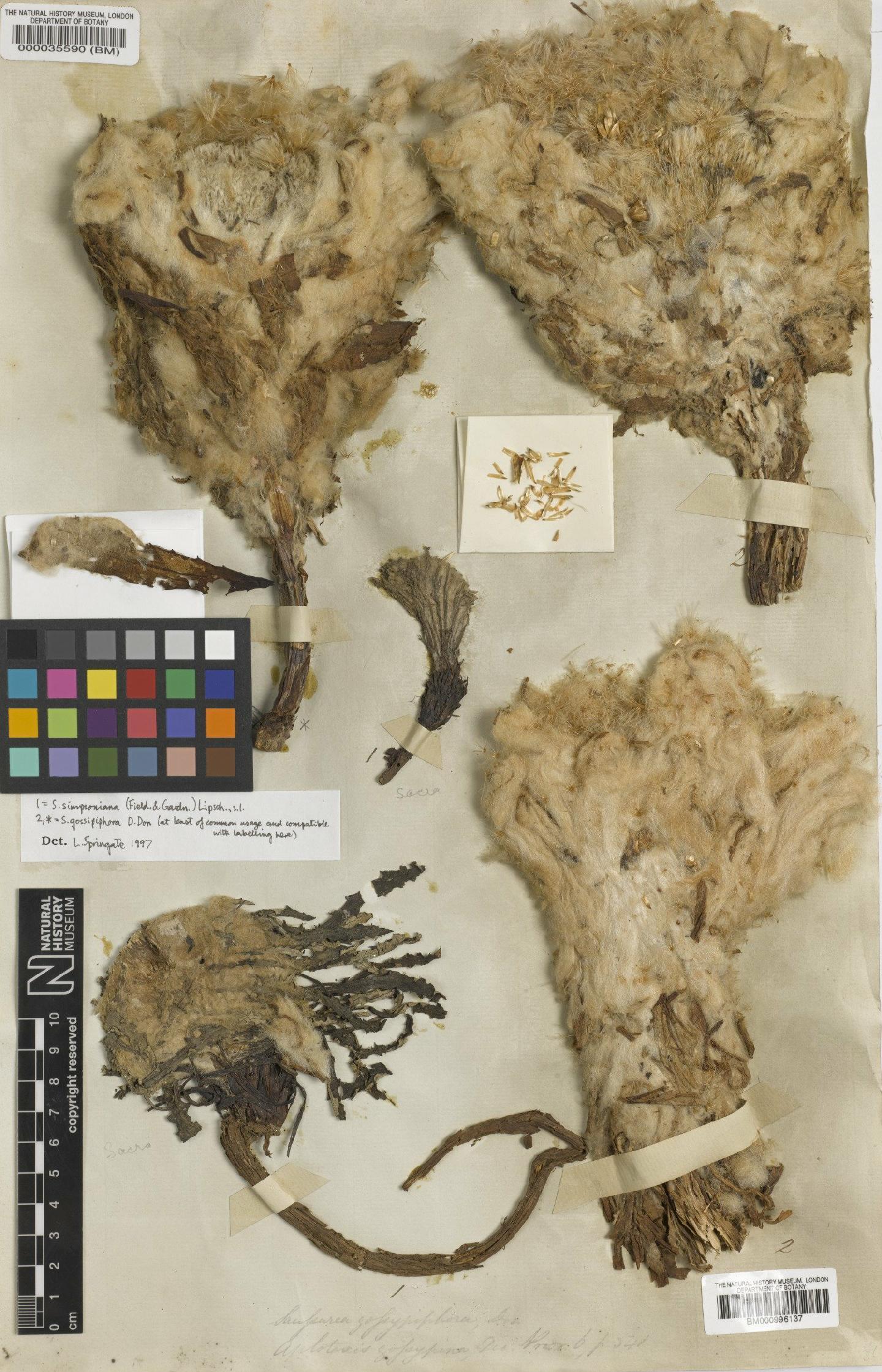
In view of what came later, it should be pointed out that Don correctly placed the plant in De Candolle’s genus Saussurea and was therefore justified in altering Wallich’s unpublished epithet to the more precise ‘cotton bearing’ (rather than merely ‘cottony’); at this point Don could have had no idea that Wallich himself had begun to publish new species in distant Calcutta. Lambert’s herbarium was sold after his death, and this specimen can now be found at the Natural History Museum, London.
In 1821, Wallich was able to visit Nepal, but his movements restricted to within the ring of mountains encircling the Kathmandu Valley. However, his Indian collectors revisited Gossainthan to recollect this iconic herb and record its growing conditions. Wallich described the plant and its habitat in evocative, not to say romantic, words as quoted in a letter of 30 August 1821 written by Henrietta Loring (née Kindersley) to her cousin James Edward Smith in Norwich:
Dr Wallich has sent us from Napal a Botanical wonder, w[hic]h he begs us to forward to you – here is an extract from his letter to my Husband on the subject –
“I must send you for Mr Loring the enclosed specimen of a snug & warm Winter Deep of a plant – This little plant of Cotton grows on barren rocks, above Gossain Than, where it is at once exposed both to the most rigorous Winter & in summer to a very hot sun & the most tremendous rains.– This fine plant constitutes a new Genus, which I call Eriocoryne [Greek letters for erion koryne] clava lanata [i.e. woolly club] & the species I call Eriocoryne nidulans [lying in a nest – referring to the capitula].– Now if you could possibly oblige me by sending this specimen to Sir J.E. Smith, you would both communicate an acceptable thing, & at the same time highly oblige me.– At the same time it would not be amiss to tell that great Botanist, that I wish he had not coined for his plant that beautiful name Eriocalia [an Australian umbel], since it has deprived me of so apt & excellent a name for my Himalah plant.– What a fine thing it would have been if I could have called it with Sir James the Cotton Nest! The number of new & most interesting things which I have already received from Gossain Than exceed all my expectations.– But you shall see them all, & Sir J.E. Smith shall have his Lion’s share”. (Linnean Society. ADD/ 52_1).
The duplicate specimen Lambert passed on to Smith also survives in the herbarium of the Linnean Society annotated ‘On barren rocks, above Gossain Than. Dr Wallich, 1821’ (LINN-HS 1314.1).
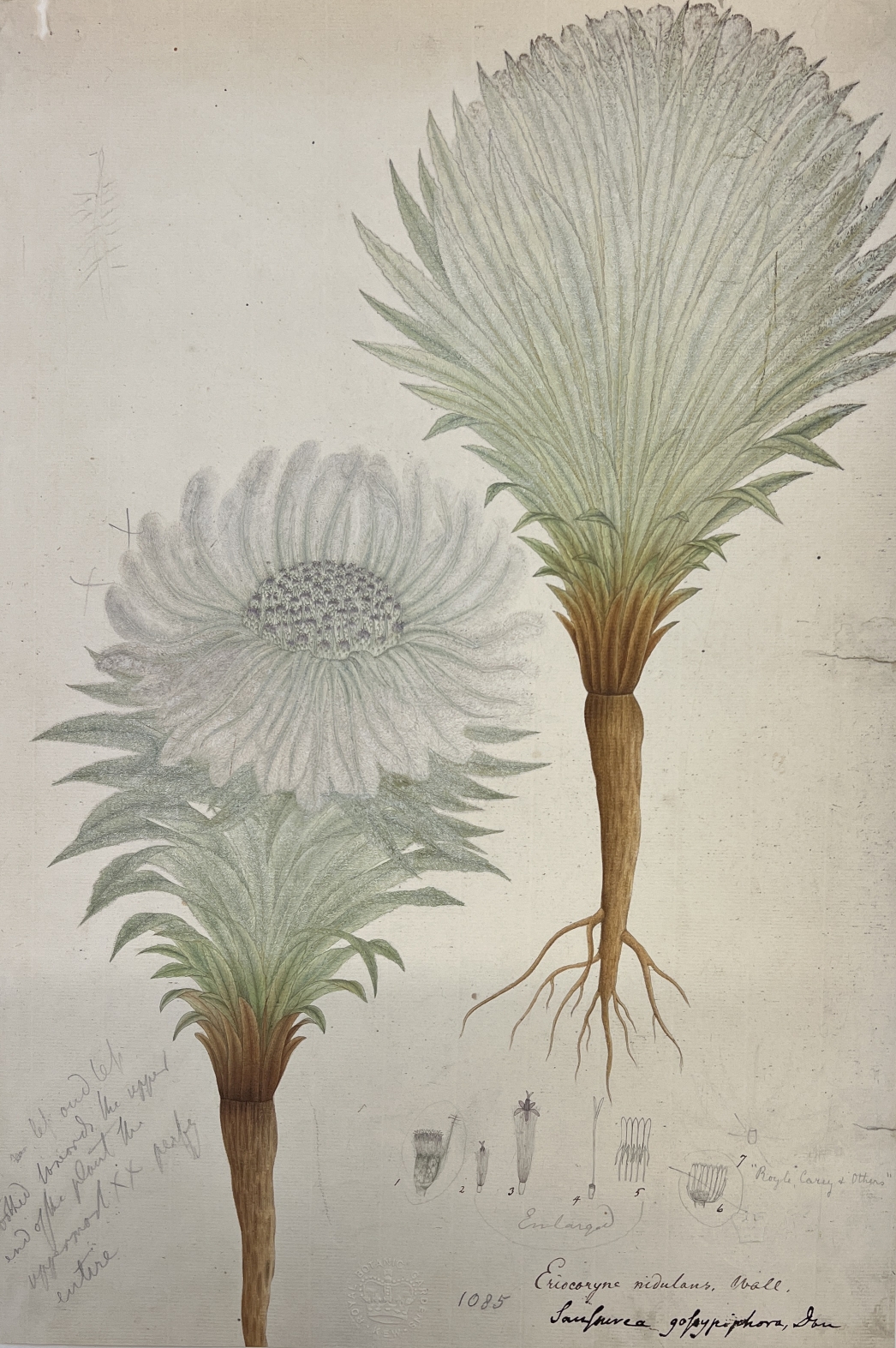
While in Nepal Wallich had the specimen drawn by his head painter Gorachand, which was reproduced as a lithograph by Maxim Gauci in Plantae Asiaticae Rariores (2: t. 138, 1831) under the superfluous (and therefore illegitimate) name Saussurea gossypina. In the text is a blisteringly sarcastic swipe against the unfortunate David Don, and what Wallich saw as his presumptuous renaming of the plant. Despite this, and on grounds of priority, its correct name remains Saussurea gossipiphora, as first described by Don in 1821 and later included in his Prodromus Floræ Nepalensis (p 168, 1825).
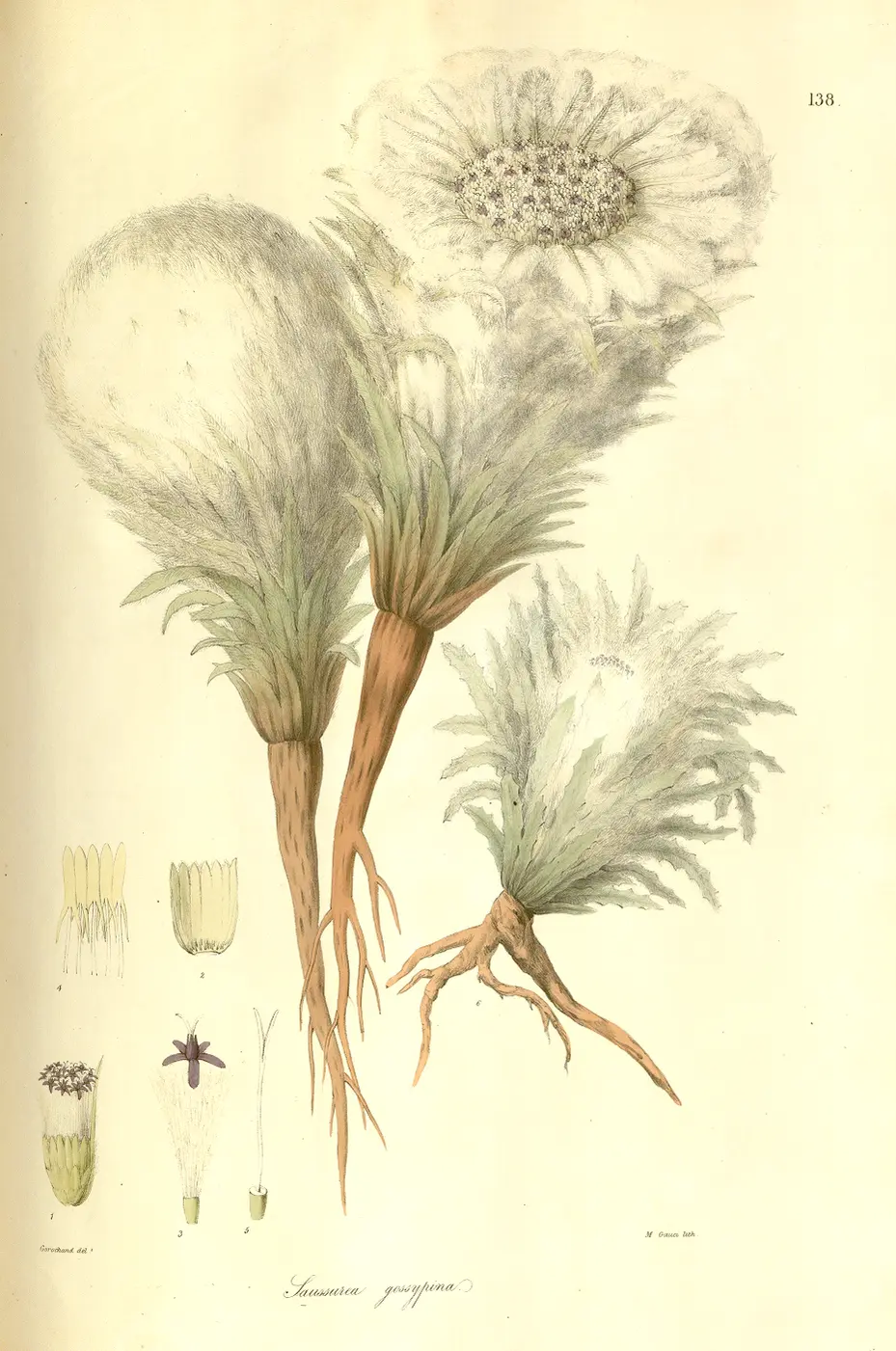
The back story to this, and the swipe, is given in Wallich’s account of the plant in his Plantae Asiaticae Rariores (2: 32. 1831):
The author of the Prodromus Floræ Nepalensis, with that delicacy of feeling which does him such infinite credit, and which he has uniformly evinced ever since he has done me the honour to avail himself of the harvest gathered by myself and my native assistants, exercises his talents as a scholar, by castigating the specific name gossypinus, which I had given to the plant [Cnicus gossypinus], and substituting gossipiphora for it, I presume on the same ground which prompted him to disapprove a name given to another plant by the first living botanist [i.e. William Roxburgh] on the following classical terms “nomen (Spermadictyonis) nimis auris terribile est servatum” [the name of Spermadictyon is too frightful to the ear to be kept].
The last sentence refers to the fact that for Spermadictyon Don had preferred the later name Hamiltonia, although as this was also coined by the very same ‘first living botanist’ it was certainly not intended as a slur against Roxburgh but, rather, in order to spare the sensitive ears of classically trained late Georgians.
It should be noted that when waxing lyrical to his cousin about the beautiful cottony bird’s nest Wallich had chosen to forget his own earlier epithet of gossypinus. When it came to his curation of the East India Company (‘Wallich’) Herbarium Wallich did, however, do the decent thing and give the correct (i.e. earliest) name, with a reference to Don’s Wernerian Society paper both on the field ticket, and in the printed Catalogue. The 1821 Gossain Than specimens are Wall. Cat. 2910A with another collection, made by Robert Blinkworth at the Garhwal Srinagar, as 2910B.
In general, specimens distributed with the Wallich Catalogue were sent to botanists only after 1828 when Wallich was based in London. These Lambert and Smith specimens of Saussurea gossipipohora, eagerly rushed to England from Nepal via Henrietta Loring in Calcutta, are a rare exception. However, care is needed when equating with the Wall. Cat. 2810A specimens as another species of Saussurea has been inadvertently mixed into the material distributed.