
The following blog was written by Natalie Zarte a digitiser in the Herbarium.
Since 2021 we have increased our digitisation capacity reaching 1 million specimens imaged in August 2024. Each digitiser is assigned a family or group of plants to work through.
Did you know?! That the Herbarium houses the most weird and wonderful things?
As part of our mass digitisation programme, I am currently working my way through the British lichen collection.
Lichens are in themselves quite a marvellous organism. Created when fungi come together with an algae and/ or cyanobacteria. It is a symbiotic relationship (Fun fact, lichens were the first organism for which the term symbiosis was used in biology). In this partnership, the fungus provides a safe space for the algae- cyanobacteria to live in. In return, the cyanobacteria provides the fungus with nitrogen, while the algae produces sugar during photosynthesis (which the fungus can`t do itself).
This special symbiotic partnership has allowed lichens to colonise almost every environment, from sea rocks to the highest mountain top and deserts. They are found on every continent, this includes even the Arctic and Antarctic! They choose the most unexpected substrates to grow on, which makes for wonderful surprises in our collection. Today I would like to share a find with you, that got me so excited, I had to show everyone I could get my hands on, so I thought you might be just as curious…
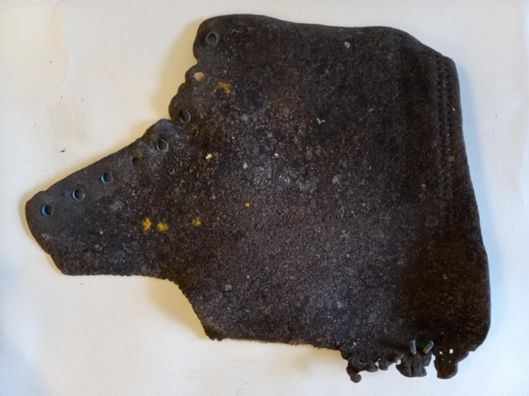
These lichens have chosen an old leather shoe as substrate!
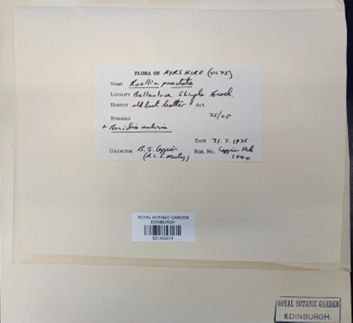
It was collected in 1975 by Brian J. Coppins (an ascomycete taxonomist in the herbarium at that time) on a shingle beach in Ballantrae, Scotland (E01405074).
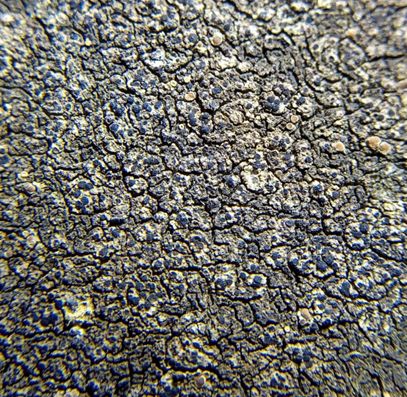
The shoe is filed in our collection under the species Amandinea punctata (Hoffm.) Coppins & Scheid, however several lichen species settled on this substrate and are visible in this close up. Amandinea punctata is usually found on wooden and rocky substrate. This crustose lichen is brown to grey in appearance, it can look greener on more nutrient rich substrate. It is also called the tiny button lichen. If you look at this close up, you can see a lot of small, black dots, those are the apothecia.
Apothecia are the fruiting bodies of lichens and are formed by the fungal partner of the lichen. These little structures are responsible for dispersing the spores and therefore, are crucial for reproduction.
Did you notice, that in this case, the collector is one of the authors for the name?
Brian Coppins collected a specimen of this lichen and then together with Scheid described it as a new species in 1993!
As beautiful as this specimen is, to house these unusual items in our collection can also be a challenge. Oversized and bulkier items, not only take up more space in our cabinets, they can also pose the threat of damaging other specimens if they are being stored incorrectly. More about fragile lichens and their proper packaging in another post…
This old tough leather shoe however, is perfectly fine in one of our folded packets.
Kevin
Thanks for a real view into the Herbarium. This invisible work and care leaves a rich legacy. Thanks for sharing