
The following blog was written by Rose Kent a digitiser in the Herbarium.
Since 2021 we have increased our digitisation capacity reaching 1 million specimens imaged in August 2024. Each digitiser is assigned a family of plants to work through. This series of blogs will spotlight the families that have been completed by a member of the team.
The Grossulariaceae (the currant family) is a family of flowering shrubs found in the temperate regions of the Northern hemisphere as well as the cooler alpine habitats of the Southern hemisphere. There is only one genus in the family, Ribes L, which contains around 200 species. The family includes the edible currants, such as blackcurrant (Ribes nigrum L.), redcurrant (Ribes rubrum L.), and gooseberries (Ribes uva-crispa L.).
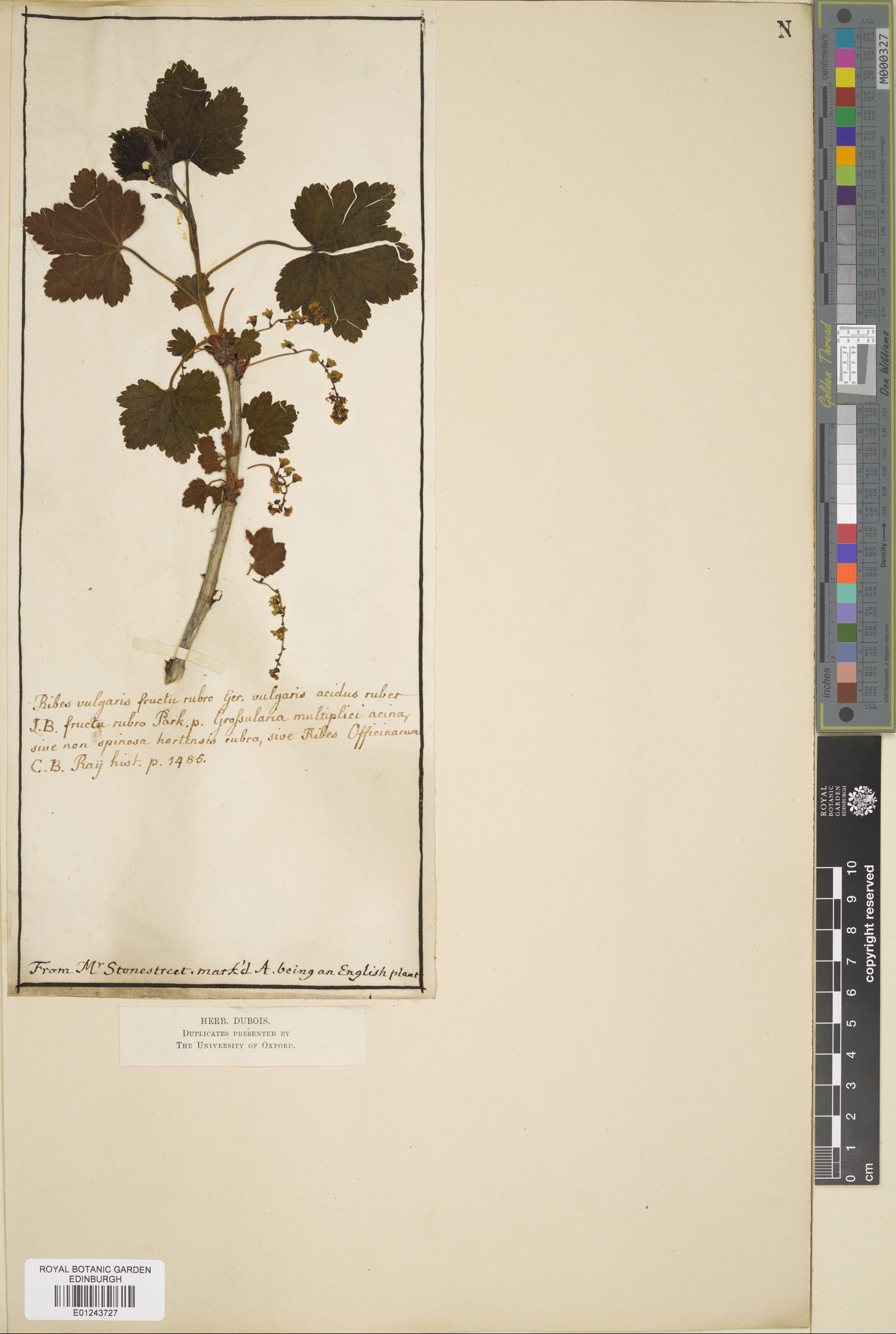
The Flowering Currant (Ribes sanguineum L.)
There is a group of flowering currants that grow through the iron railings near the bus stop on Brandon Terrace, at the edge of the Water of Leith. In March, their pendant racemes will festoon the railings and dangle out onto the pavement nearby. The smell of their leaves and flowers is sweet and resinous, and is a reassurance that Spring is very nearly here. For me, they are one of the delights of the walk from the city centre to the RBGE science buildings. Thankfully, it is not long now until they fall into flower once again.
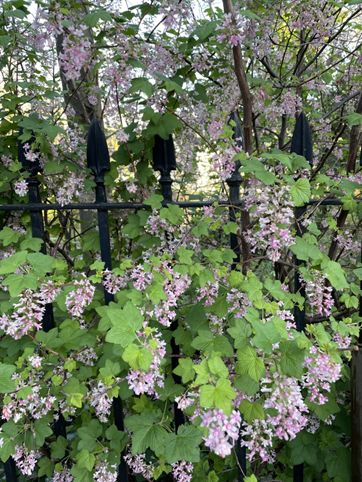
Ribes sanguineum L. (known colloquially as flowering currant) is native to the West of North America and was first introduced to the UK in 1826 by the Scottish botanist and plant collector David Douglas (after whom the Douglas fir, Pseudotsuga menziesii, was named). Douglas was funded by the Royal Horticultural Society to find and collect plants in North America for cultivation in British gardens. In a journal recording one of his collecting trips to the north-western coast of North America, Douglas gives a description of the native Ribes sanguineum, on 12th April 1825:
flowers beautiful pink colour, inside of the petals and anthers white, in large racemes. This exceedingly handsome plant is abundant on the rocky shores of the Columbia [river] and its branches, and in such places produces a great profusion of flowers, but little fruit […]I am happy to send a good portion of its seed.
Of the seeds Douglas sent to the UK, the flowering currant (and its cultivars) gained especial popularity, being grown as an ornamental shrub in many British gardens, parks, and hedgerows. Its popularity was so immense, in fact, that John Lindley later stated that even if it had been the only plant Douglas produced from his trip to North America, it would have been well worth the expense of the whole expedition.
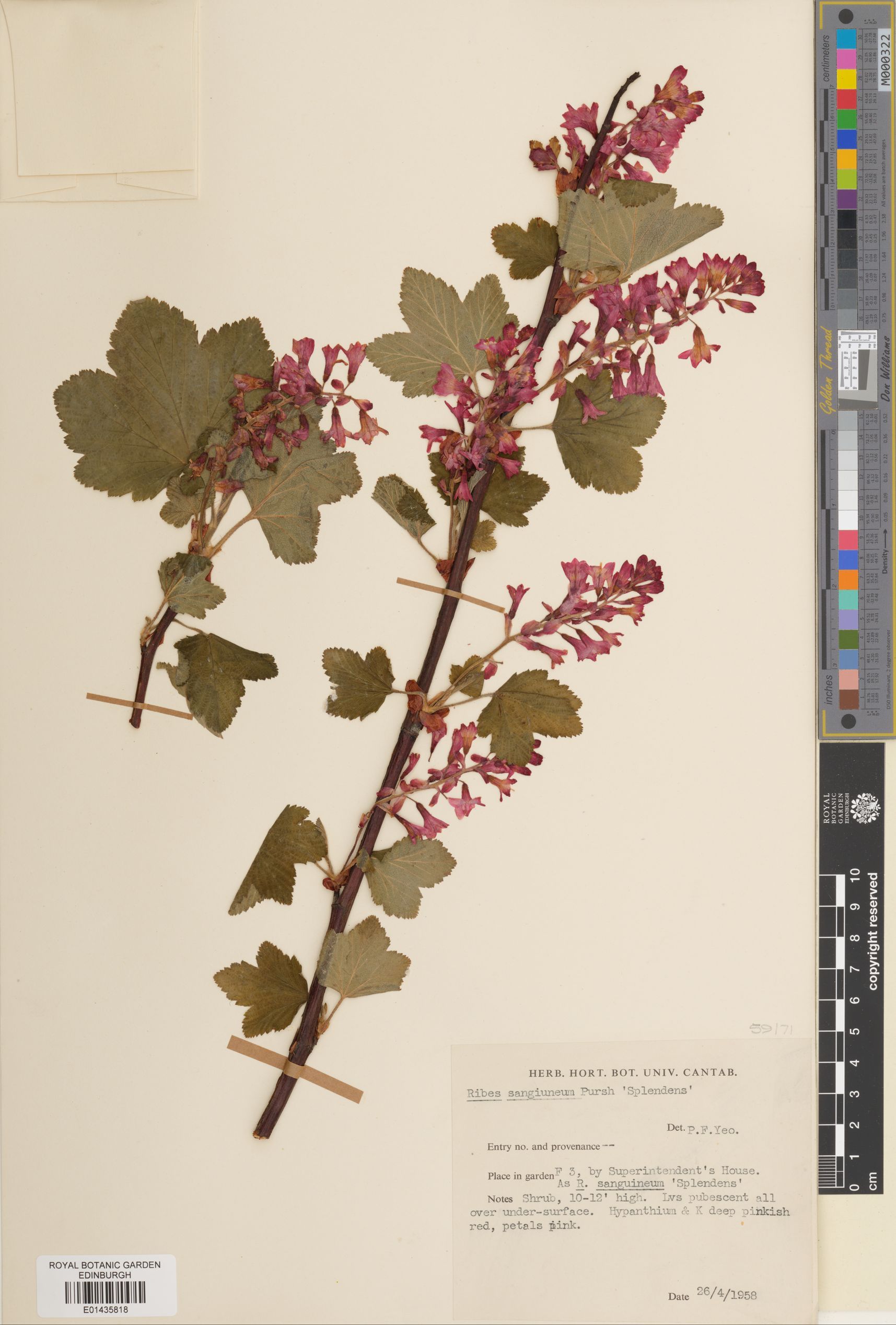
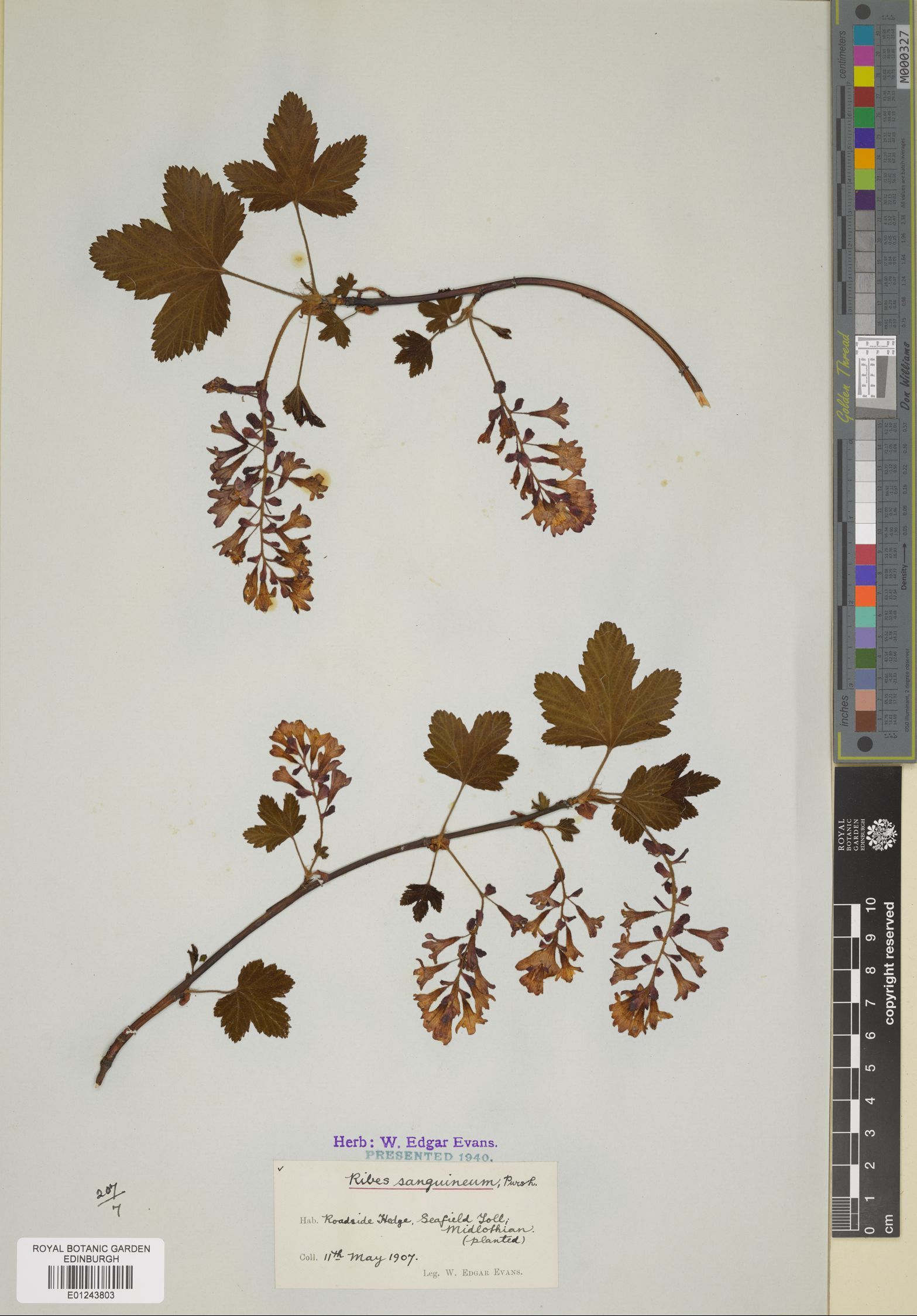
A coloured photograph of the shrub taken from Gertrude Clarke Nuttall’s book Beautiful Flowering Plants (1922) captures, in sepia tones, the elegance of the plant. The colours of the photograph echo the faded browns, greens, and pinks of the specimens that have been pressed, dried, and preserved in the herbarium.
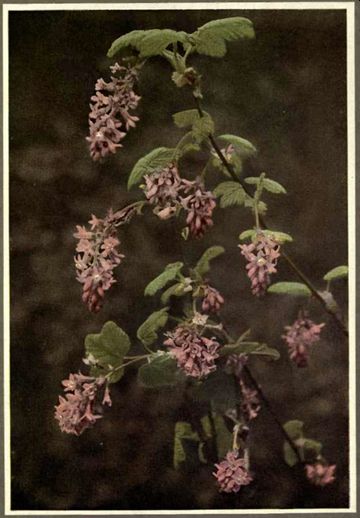
Gertrude Clarke Nuttall (1867-1929) was one of the first women to undertake a degree in botany, and describes Ribes sanguineum L. as follows:
the whole shrub, with its roseate flower cascades drooping beneath the half-formed fresh green foliage, is a perfect picture of vivid spring beauty […] Its charm is intensified by the incense-like fragrance that it exhales…
Nuttall, 1922
The dark mottled background of this photograph almost evokes the “incense-like fragrance” that Nuttall describes. Blotches in the background appear smoky, like clouds of incense, hanging heavily in the air surrounding the plant. The photograph grasps at a visual depiction of the plant and its smell – it is an image that is strangely “incensed.”
General characteristics of the family
Plants in the Grossulariaceae often have lobed leaves that alternate along the stem. These leaves can be hairy, glandular, aromatic, and/or waxy. Flowers often grow in racemes and vary in colour from green to dark pink to yellow depending on the species. The sepals, petals, and stamens are fused at their bases to form a cup-like structure known as a hypanthium. Flowers are mostly 5-merous with sepals (outer lobes) that are often significantly larger than those of the petals. Their fruits are true botanical berries, meaning they are derived from a single ovary of an individual flower. Whilst once included in the broader circumscription of Saxifragaceae s.l., the group is now considered to be a separate family, sister to Saxifragraceae s.s.
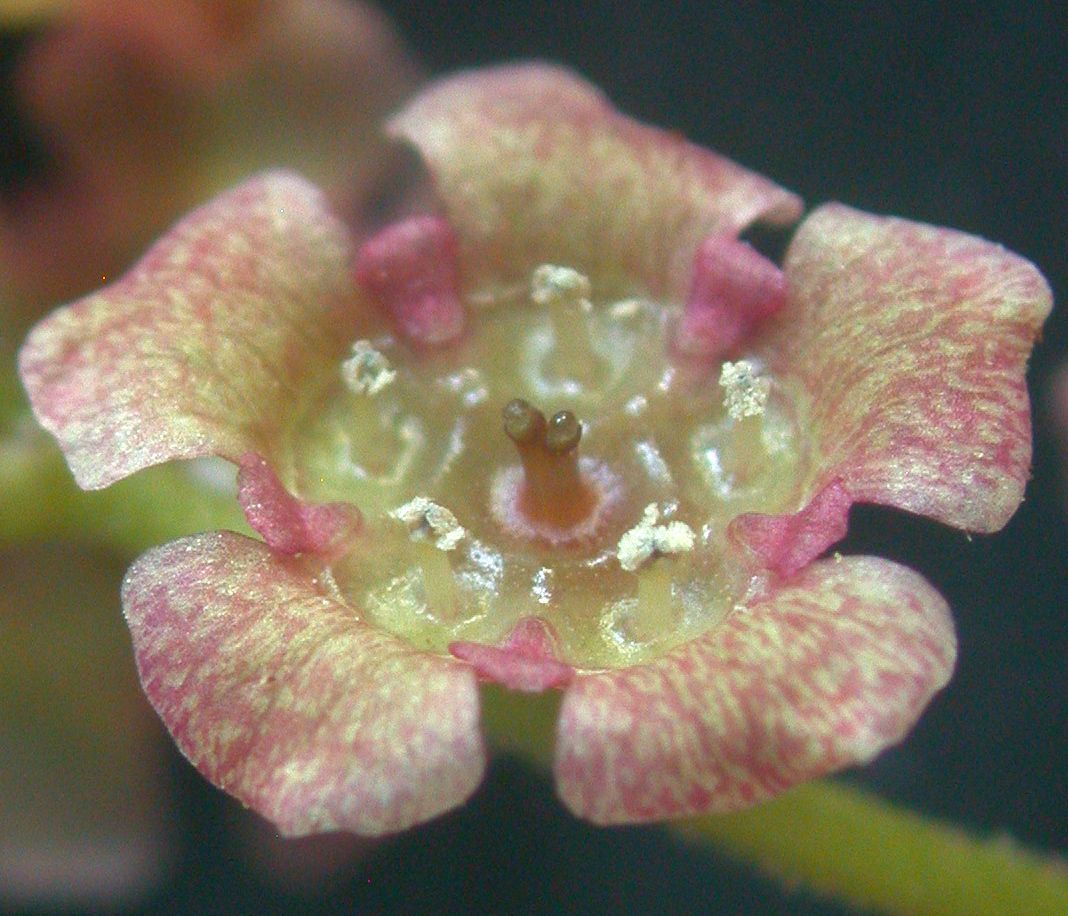
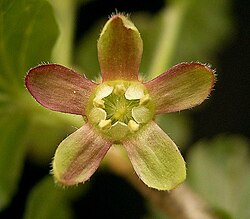
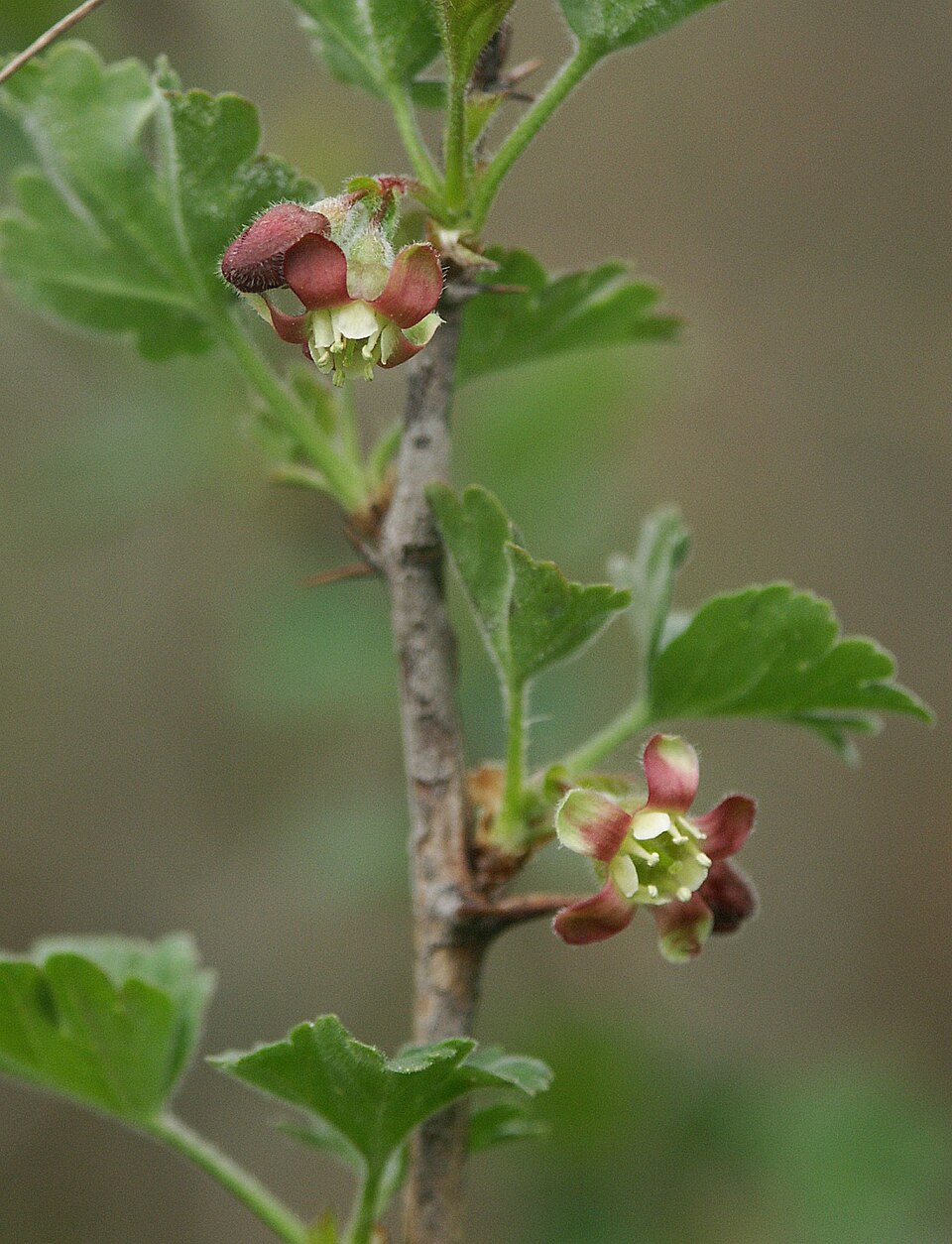
Photographs of Ribes flowers: Ribes triste (left), Ribes uva-crispa (centre), Ribes uva-crispa (right). Sourced: Wikimedia Commons


Our Collections
We hold 2,533 specimens, including 23 type specimens. The specimens can be viewed here.
Top 5 regions
| No. of Specimens | Herbarium Filing Region |
| 641 | North America |
| 433 | Inner China, Korea and Taiwan |
| 316 | Cultivated |
| 266 | Britain and Ireland |
| 165 | Europe (excl. Britain and Ireland) |