The following blog was written by Lindsay Middleton a digitiser in the Herbarium.
Since 2021 we have increased our digitisation capacity reaching 1 million specimens imaged in August 2024. Each digitiser is assigned a family of plants to work through. This series of blogs will spotlight the families that have been completed by a member of the team.
Cornaceae is a family of primarily trees and shrubs, commonly known as dogwoods.
Cultivars are popular with gardeners for winter colour like the red stems of Cornus alba ‘Aurea’, and for spring/ summer flowering cultivars such as Cornus Kousa with white to pink flowers. Cornus mas from Europe, introduced into Britain by 1551, is also known as the Cornelian cherry and has edible fruits.
There are currently two accepted genera in the family, Alangium and Cornus with 57 and 51 accepted species respectively. Cornus is distributed across northern regions, Eurasia to Indochina and North America, at high elevations in Africa, also Central America to Bolivia. Alangium is distributed from Africa to Asia.
Our Collections
In total, there are now 2,593 digitised specimens. Before digitisation the family had 597 records, so this has increased by nearly two thousand specimens. Cornus is the largest genus with just over two thousand specimens.
The specimens can be viewed here.
Top 5 regions
| No. of Specimens | Herbarium Filing Region |
| 805 | Inner China, Korea and Taiwan |
| 473 | North America |
| 190 | Britain and Ireland |
| 184 | Cultivated |
| 157 | Europe (excl. Britain and Ireland) |
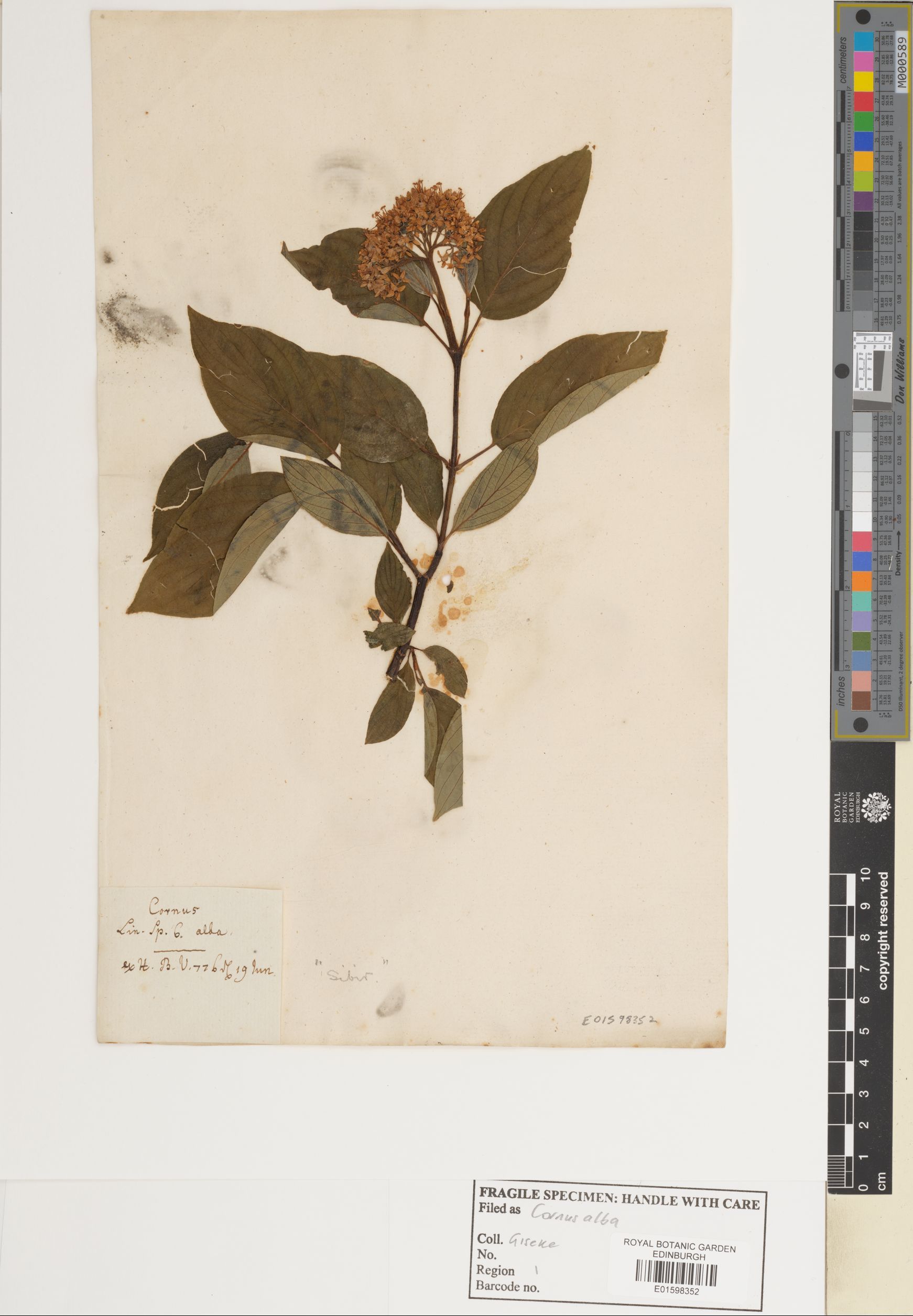
The collection includes some rare Gieseke collections from the 1700’s which are now available to view online such as this Cornus alba from 1776