
The following blog was written by Natalie Zarte a digitiser in the Herbarium.
Since 2021 we have increased our digitisation capacity reaching 1 million specimens imaged in August 2024. Each digitiser is assigned a family of plants to work through. This series of blogs will spotlight the families that have been completed by a member of the team.
In some of earth’s most extreme and nutrient-poor environments, neither fungi nor algae could survive alone, but in a symbiotic relationship they are actually able to grow. I know it sounds dramatic, but this is how lichens are the first organisms to establish themselves in habitats where nothing else would thrive.
In my last blog I mentioned that lichens can go dormant in harsh environments. This neat trick allows them to even survive in outer space!
How do we even know? You might ask…
In 2005 Leopoldo G. Sancho from the University of Madrid experimented with two species of lichen. Samples were launched from Baikonur by a Soyuz rocket and returned to Earth after 16 days. Being exposed to outer space (the vacuum, the high extra-terrestrial solar UV radiation, the extreme temperature; -20°C.) has proven to be lethal to bacteria and other microorganisms. However, the lichen species in this experiment were able to recover within 24 hours and resume photosynthesis! On top of being poikilohydric to survive desiccation, dormancy to deal with low temperatures, the lichen`s upper cortex equips it with enough protection to even withstand solar radiation.
But why put the poor lichens through such an ordeal? This experiment has shown that lichens can survive extreme conditions. Making them the one organism that has the potential to establish life on other planets. On our lovely Earth, lichens have already proven that they can transform hostile habitats from bare rock to a species rich biotope. Be it after a volcanic eruption or bare rock emerging from a glacier. Lichens are a pioneer organism. Paving the way for other organisms like mosses to take hold, slowly transforming environments from bare rock to forests.
The two species Leopoldo used in his experiment are Rhizocarpon geographicum and Xanthoria elegans.
Let`s have a look at Xanthoria elegans first.
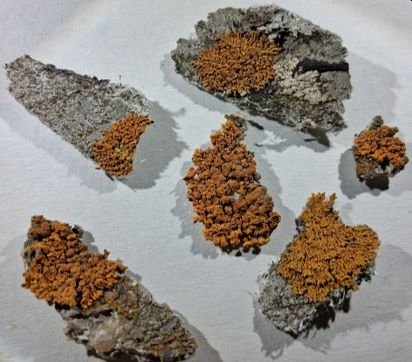
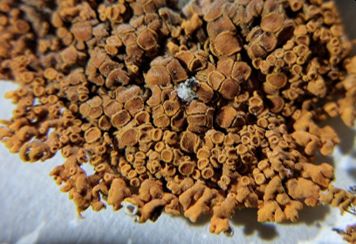
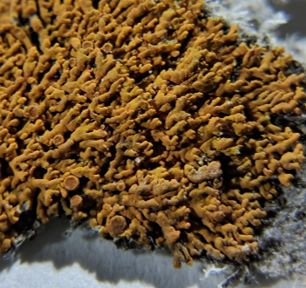
These specimens were collected by Ursula Duncan in September 1967 in Kincardine, Scotland (E01593518).
This species is also called the “elegant sunburst lichen”, due to its orange to red colour. It is a fairly slow growing lichen, with only 0.5mm growth per year for the first 100 years, after which it slows down even further! It is often found close to where birds perch or small mammal droppings can be found.
The second species which was used in the experiment was Rhizocarpon geographicum.
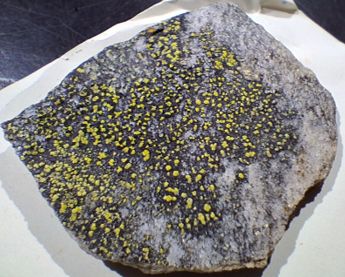
Rhizocarpon geographicum is a yellow-green lichen. It is a crustose lichen, growing in yellow patches, often bordered by black lines, giving it the common name of “map lichen”. It thrives on exposed, preferably dry and sunny rocks. It is very sensitive to changes in environmental conditions, especially regarding air pollution, making it very valuable in monitoring the health of ecosystems.
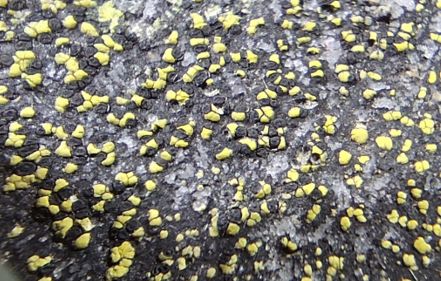
This close up clearly shows the yellow areoles (segments, which are usually surrounded by a black line of fungal hyphae.)
And the black apothecia (the fungal partners sexual reproductive structure, producing the spores).